

 United Kingdom
 Germany
 Argentina
 Australia
 Canada
 New Zealand
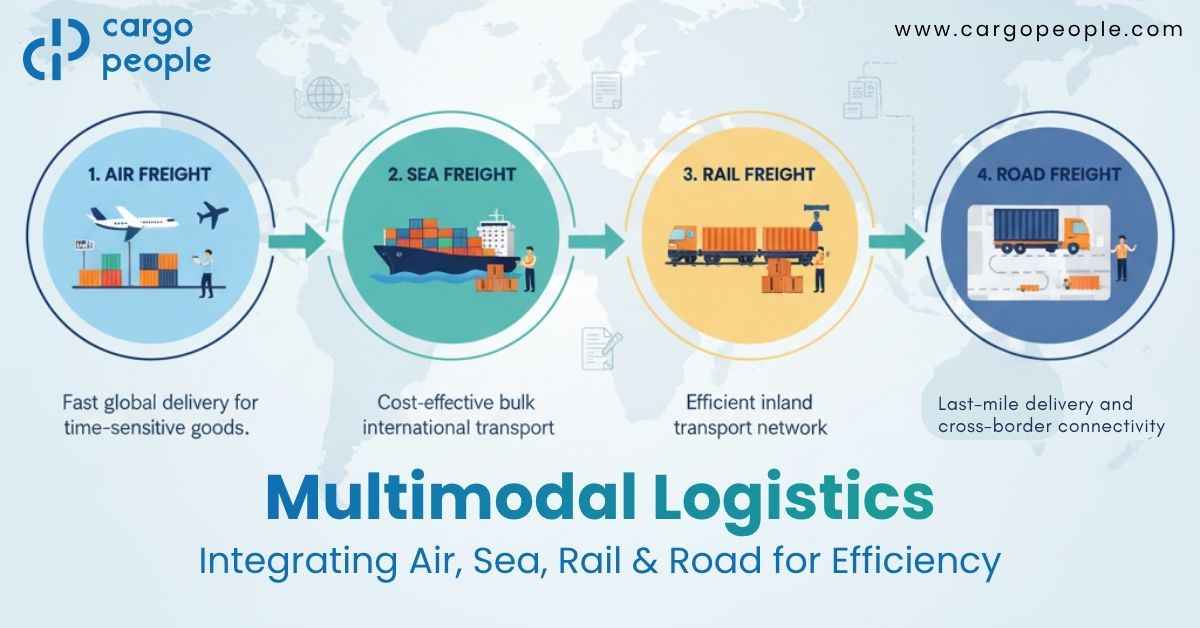
When Arora Exports Pvt. Ltd., a small auto component manufacturer in Pune, began expanding into European markets, their biggest challenge wasn’t finding clients — it was delivering shipments on time. Despite using reliable shipping lines, their containers often faced delays at ports, and inland transport coordination became a nightmare.
Frustrated by rising costs and uncertain delivery schedules, the company partnered with GlobeConnect Logistics, which proposed a multimodal transport plan. Instead of relying solely on sea freight, they combined rail for inland movement and sea freight for exports via Mundra Port. Within three months, the company reduced its transit time by 30% and saved nearly ₹3.2 lakh per shipment.
This success story reflects a larger shift in India’s trade environment — where multimodal logistics is transforming how goods move across borders, blending efficiency, reliability, and cost control into one seamless framework.
What Is Multimodal Logistics and Why It Matters for Indian Businesses
Multimodal logistics is the integration of two or more transport modes — such as air, sea, rail, and road — under a single contract managed by a Multimodal Transport Operator (MTO). This structure provides one point of accountability and ensures smooth cargo transition across multiple carriers and terminals.
Why It’s Becoming Critical for India’s Exporters
India’s trade growth depends heavily on efficient logistics. With logistics costs hovering around 8% of GDP, inefficiencies in transportation directly impact export competitiveness.
For manufacturers and exporters, multimodal logistics offers:
-
Streamlined documentation with a single Bill of Lading.
-
Reduced handling and dwell time at ports and terminals.
-
Predictable delivery schedules, improving buyer confidence.
-
Lower transportation costs by choosing optimal mode combinations.
-
Compliance assurance through standardized procedures and visibility.
In a market where on-time delivery can define business success, multimodal logistics bridges the gap between speed and cost-efficiency.
Modes of Transport in Multimodal Logistics — A Comparative View
India’s diverse geography and growing export hubs demand flexible logistics. Here’s how different modes complement each other under a multimodal system:
| Mode | Key Benefit | Average Cost (₹/tonne-km) | Best Use Case | Limitation |
|---|---|---|---|---|
| Road | Quick door-to-door delivery | 11.03 | First and last-mile connectivity | Affected by congestion and fuel costs |
| Rail | Bulk, long-distance transport | 1.96 | Heavy cargo from factories to ports | Fixed routes, limited flexibility |
| Sea | Cost-efficient for exports | 2.5–3.0 | Large shipments, international trade | Longer transit time |
| Air | Fast and reliable | 25–30 | Urgent or high-value shipments | Expensive for bulky goods |
How Integration Creates Value
By combining these modes intelligently, businesses can maximize efficiency. For example, exporters from Ludhiana can move cargo by rail to Mundra Port and then ship by sea to Europe. Similarly, time-sensitive products like electronics from Bengaluru can use air + road routes for global delivery within days.
This flexibility gives companies better control over timelines, pricing, and customer satisfaction — all under a single logistics contract.
India’s Multimodal Push — Infrastructure and Policy in Action
Over the past few years, India’s logistics sector has undergone a remarkable transformation. Government initiatives, private partnerships, and digital reforms are collectively building a more connected, multimodal ecosystem.
Multi-Modal Logistics Parks (MMLPs)
India plans to develop 35+ state-of-the-art MMLPs that link rail, road, and inland waterways under one infrastructure network. Each park will include warehousing, customs facilities, and intermodal terminals.
Examples:
-
Mundra (Gujarat): A western gateway integrating port, rail, and road.
-
Jogighopa (Assam): Enhancing connectivity for the Northeast through waterways.
-
Nagpur (MIHAN): India’s central air cargo hub connecting industrial zones to seaports.
Inland Waterways — The Next Growth Engine
India’s inland waterway network, including the Haldia–Varanasi stretch, is now facilitating container movement directly from eastern ports to hinterland markets. This mode is nearly 30% cheaper than road transport, making it ideal for heavy bulk goods like cement, coal, and fertilizers.
Emerging Trade Corridors
-
INSTC (International North-South Transport Corridor): Links Mumbai to Europe via Iran and Russia — cutting transit time by nearly a third.
-
Kaladan Project: Connects Kolkata Port to Myanmar’s Sittwe Port, opening new trade routes to Southeast Asia.
Together, these initiatives are reducing India’s logistics cost, improving delivery reliability, and positioning the country as a global logistics hub.
How Indian Exporters Can Optimize Multimodal Operations
Implementing multimodal transport requires strategy, coordination, and the right partnerships. Here’s how exporters can maximize efficiency:
1. Select the Right Mode Combination
Analyze your cargo profile, destination, and urgency. For bulk goods, rail + sea provides cost advantages. For smaller, urgent shipments, air + road ensures speed without excessive costs.
2. Partner with a Certified MTO
A registered Multimodal Transport Operator simplifies compliance, ensures legal protection, and manages documentation from factory to destination. This reduces operational stress for exporters.
3. Digitize Logistics Processes
Adopt Electronic Data Interchange (EDI) systems for customs clearance, use GPS-enabled vehicles for tracking, and integrate analytics for real-time visibility.
4. Manage Customs and Regulatory Compliance
Ensure accurate documentation, match consignee details across invoices and Bills of Lading, and pre-clear shipments through customs portals to avoid detention.
5. Plan Last-Mile Efficiency
Use connected transport infrastructure — rail sidings near industrial clusters and inland container depots (ICDs) — for quick port access.
By implementing these steps, exporters can cut operational costs, improve predictability, and deliver faster than competitors.
Freight Cost Comparison (Indicative for 2025)
| Route | Mode Combination | Transit Time (Days) | Average Cost (₹/kg) | Ideal Cargo Type |
|---|---|---|---|---|
| Mumbai → Rotterdam | Sea Only | 28–32 | 115 | Bulk cargo |
| Mumbai → Rotterdam | Rail + Sea | 20–25 | 98 | Medium-value goods |
| Delhi → Dubai | Air | 2–3 | 450 | Urgent, high-value items |
| Delhi → Dubai | Air + Road | 3–4 | 330 | Fashion, electronics |
Insight:
Strategically combining transport modes can cut overall freight costs by 20–25%, enabling exporters to improve margins without compromising delivery timelines.
Compliance and Operational Risks — Real Case Insight
In 2023, a textile exporter from Tirupur faced a ₹1.8 lakh customs penalty when their container was detained at Nhava Sheva. The issue? A mismatch between the consignee details on the multimodal Bill of Lading and the export invoice.
Consequences:
-
Six days of port detention.
-
Additional storage and demurrage fees.
-
Delayed delivery, impacting buyer confidence.
How It Could’ve Been Avoided:
Proper coordination between freight forwarder, customs agent, and transport operator is essential. Partnering with a certified MTO could have ensured consistency across documentation and prevented costly errors.
Mini Business Stories — Success Through Integration
-
Arora Exports Pvt. Ltd. (Pune): Switched from single-mode sea freight to rail + sea combination, reducing transit time by 30%.
-
Skyline Engineering (Vadodara): Adopted sea + rail via Mundra Port, cutting delivery to Eastern Europe by 9 days.
-
MedCare Pharma (Nagpur): Utilized MIHAN air cargo hub and connected roads for exports to the Middle East, achieving 98% on-time delivery.
Each of these businesses showcases how integrated logistics planning converts operational challenges into competitive advantages.
Benefits of Adopting Multimodal Logistics
-
Lower Costs: Up to 25–30% reduction in logistics expenses.
-
Simplified Documentation: One contract and one operator streamline processes.
-
Faster Deliveries: Optimized routes improve speed and consistency.
-
Sustainability: Rail and waterways cut carbon emissions significantly.
-
Resilience: Multi-route flexibility protects against port congestion or strikes.
These benefits not only strengthen supply chain efficiency but also enhance a company’s credibility in international trade.
FAQs
1. What is multimodal logistics?
It’s the integration of two or more transport modes under a single contract for efficient and cost-effective cargo movement.
2. How does it benefit exporters?
It simplifies documentation, reduces cost, and ensures faster delivery across routes.
3. Which mode is most cost-effective in India?
Rail and inland waterways are the cheapest per tonne-kilometer for bulk transport.
4. What documents are required?
A multimodal Bill of Lading, invoice, packing list, IEC, and shipping bill are mandatory.
5. How can Cargo People help?
Cargo People designs multimodal solutions that reduce costs, streamline customs, and ensure on-time international deliveries.
Conclusion — The Road Ahead for Indian Logistics
As global trade becomes faster and more competitive, multimodal logistics is the foundation of sustainable growth for Indian exporters. It bridges infrastructure gaps, lowers operational costs, and ensures smooth compliance.
Companies like Cargo People Logistics specialize in creating customized multimodal solutions that integrate technology, infrastructure, and regulatory expertise — ensuring shipments move safely, quickly, and cost-effectively from factory to final customer.
📞 +91 78350 06245
📧 Cha@cargopeople.com
Book a Consultation with Cargo People Logistics