





 USA
USA United Kingdom
 Germany
 Argentina
 Australia
 Canada
 New Zealand
When Rajesh, an SME exporter from Delhi NCR, booked his first container to Europe, he thought the hard part was over once production finished. But at the port, his shipment was delayed because of incorrect documentation in the Bill of Entry. The delay meant extra demurrage charges and unhappy buyers. A licensed Customs House Agent (CHA) stepped in, rectified the paperwork, liaised with customs officials, and ensured clearance within hours. Without the CHA, Rajesh would have lost the deal.
This story is common across India’s trade hubs—whether in Mumbai, Mundra, Chennai, or Kolkata. But who exactly is a Customs House Agent, and why are they so important in international trade?
Customs House Agent Meaning & Full Form in Shipping
A Customs House Agent (CHA)—also referred to today as a Customs Broker under the Customs Brokers Licensing Regulations (CBLR) 2018—is a professional licensed by Indian Customs to act on behalf of importers and exporters in the customs clearance process.
- CHA Full Form: Customs House Agent
- Legal Basis: Section 146 of the Customs Act, 1962
- Purpose: Facilitate smooth clearance of goods through customs, ensuring compliance with Indian trade laws
In simpler words, a CHA is your bridge between your business and Indian Customs, ensuring that every shipment—whether by air freight or sea freight—passes all legal checks without delays.
Why Customs House Agents Matter in India’s Trade
India’s trade volumes are massive. According to WTO (2024), India’s merchandise exports touched 778 billion dollars, while imports stood at 890 billion dollars. Every consignment has to pass through customs clearance, a process full of complex rules, paperwork, and duties.
Without a CHA, importers and exporters risk:
- Delays leading to detention and demurrage charges at ports like Mundra or Nhava Sheva
- Penalties due to misclassification of HS codes or wrong declarations
- Regulatory issues such as non-compliance with DGFT notifications, GST refunds, or schemes like RoDTEP
A CHA ensures compliance and reduces clearance times. In fact, average dwell time at Indian ports has dropped by nearly 25 to 30 percent in the last five years thanks to improved systems like ICEGATE and efficient CHAs (Source: Ministry of Finance, 2023).
Regulatory Framework & CHA License in India
Not everyone can become a CHA. India follows a strict licensing regime.
Eligibility Criteria for CHA License (as per CBLR 2018)
- Indian citizenship and at least 21 years of age
- Graduate degree with preference for Law, CA, MBA, or Shipping & Logistics
- Minimum three years’ experience in customs clearance (for example, as a G-Card holder)
- Proof of financial soundness with assets worth at least five lakh rupees
Step-by-Step Process to Get a CHA License
- Submit application in Form G to the jurisdictional Commissioner of Customs
- Appear for a written exam covering Customs Act, GST, tariff classification, INCOTERMS, DGFT, and port rules
- Appear for an oral exam to test practical knowledge of customs procedures
- Obtain provisional licence after passing exams and furnishing security (₹25,000 bond at major ports)
- Secure a regular licence valid for five years (renewable) under CBLR 2018
Temporary vs Regular Licence
- Temporary CHA Licence: Valid for one year, with bond requirement
- Regular CHA Licence: Valid for five years and renewable
Checklist tip: Always verify if your CHA has a valid licence under CBLR 2018 before appointing them.
Functions, Duties and the CHA Customs Clearance Process
A licensed CHA performs multiple critical functions.
Key Duties and Responsibilities
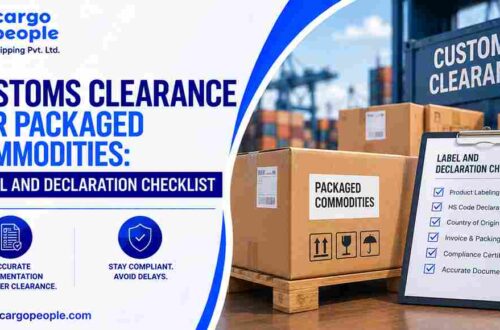
- Preparing and filing Bill of Entry (imports) and Shipping Bill (exports)
- Classifying goods under correct HS codes and calculating applicable customs duty, GST, or cess
- Liaising with customs officers, port authorities, shipping lines, and DGFT
- Ensuring compliance with schemes like RoDTEP, duty drawback, EPCG, and SEZ rules
- Maintaining import and export records for at least five years
- Handling faceless assessment through ICEGATE for faster clearance
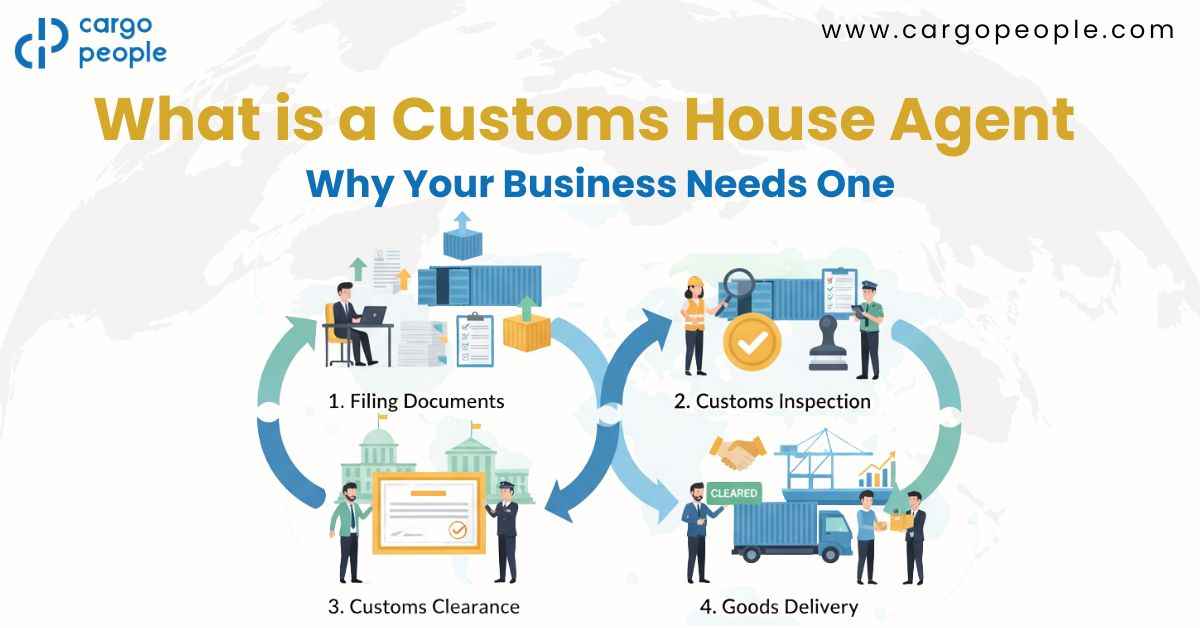
Typical CHA Customs Clearance Process in India
- Importer or exporter shares invoice, packing list, IEC code, and other documents
- CHA files the Bill of Entry or Shipping Bill via ICEGATE
- Customs system assesses duty and classification
- CHA pays duty on behalf of the client
- Customs may order physical inspection, which the CHA coordinates
- After clearance, goods are released from port or ICD
At Delhi ICD Tughlakabad, CHAs often help reduce clearance time by one to two days through proactive query resolution.
CHA and Freight Forwarder: The Difference
Many businesses confuse Customs House Agents with Freight Forwarders. The difference lies in their roles and legal responsibilities.
- A CHA is licensed by Indian Customs to handle customs documentation, compliance, and duty payments
- A Freight Forwarder arranges transportation, booking of cargo space, and logistics coordination across modes of transport
- A CHA requires a government licence; a Freight Forwarder does not
- A CHA focuses on customs clearance; a Freight Forwarder focuses on movement of goods
In practice, both services are complementary. Companies like Cargo People offer both freight forwarding and CHA services, providing an integrated logistics solution.
Choosing the Right CHA – Evaluation Framework
When selecting a CHA, businesses should check the following factors:
- Licence validity under CBLR 2018
- Port experience and specialization (for example, Nhava Sheva vs Mundra)
- Technology adoption such as EDI, ICEGATE, and faceless assessment
- Domain expertise in specific cargo categories like chemicals, pharmaceuticals, or project cargo
- Cost transparency; typical CHA fees range from 4,000 to 5,000 rupees per shipment
Choosing a partner that combines CHA and Freight Forwarding services, like Cargo People, ensures better coordination, fewer delays, and cost savings.
Business Impact – Why SMEs Should Engage a CHA
For small and mid-sized businesses, a CHA is not optional but essential.
- Faster clearances reduce port demurrage charges that can range between 5,000 to 10,000 rupees per day
- Error prevention avoids penalties under the Customs Act
- Access to trade schemes ensures smooth GST refunds and RoDTEP credits
- Peace of mind lets exporters and importers focus on their business rather than customs paperwork
For instance, a Chennai auto-parts exporter engaged a CHA to correct HS classification, reducing duty by seven percent and saving over 15 lakh rupees annually.
FAQs on Customs House Agents (CHA)
Q1. What does a Customs House Agent do in India?
A CHA manages import and export documentation, calculates duties, and ensures goods clear Indian Customs without delays or penalties.
Q2. How to become a licensed CHA in India?
File an application in Form G, clear written and oral exams, furnish financial security, and obtain a licence under CBLR 2018.
Q3. What is the step-by-step process to get a CHA licence?
Apply, pass exams, obtain a provisional licence, submit bond, and then receive a regular five-year licence.
Q4. What are CHA licence fees and requirements in India?
Applicants must provide a bond of ₹25,000 at major ports, proof of assets worth five lakh rupees, and pay exam/application fees.
Q5. What is the difference between a Customs House Agent and a Freight Forwarder?
A CHA is a licensed customs compliance professional, while a Freight Forwarder is a logistics service provider that arranges transport.
Q6. What is the role of CHA in duty drawback and RoDTEP processes?
CHAs file shipping bills with correct scheme codes, enabling exporters to receive refunds and credits efficiently.
Conclusion
So, who is a Customs House Agent (CHA)?
They are licensed professionals who make international trade hassle-free by handling documentation, duty, compliance, and customs coordination. In India’s fast-evolving trade landscape, their role is indispensable for exporters and importers.
By partnering with a CHA-cum-freight forwarder like Cargo People Logistics & Shipping Pvt. Ltd., businesses get an integrated solution covering Air Freight, Sea Freight, Customs Clearance, Warehousing, and Project Cargo Handling.
Ready to simplify your next shipment? Visit Cargo People’s Customs Clearance page and book your service today.