

 USA
USA
 United Kingdom
 Germany
 Argentina
 Australia
 Canada
 New Zealand
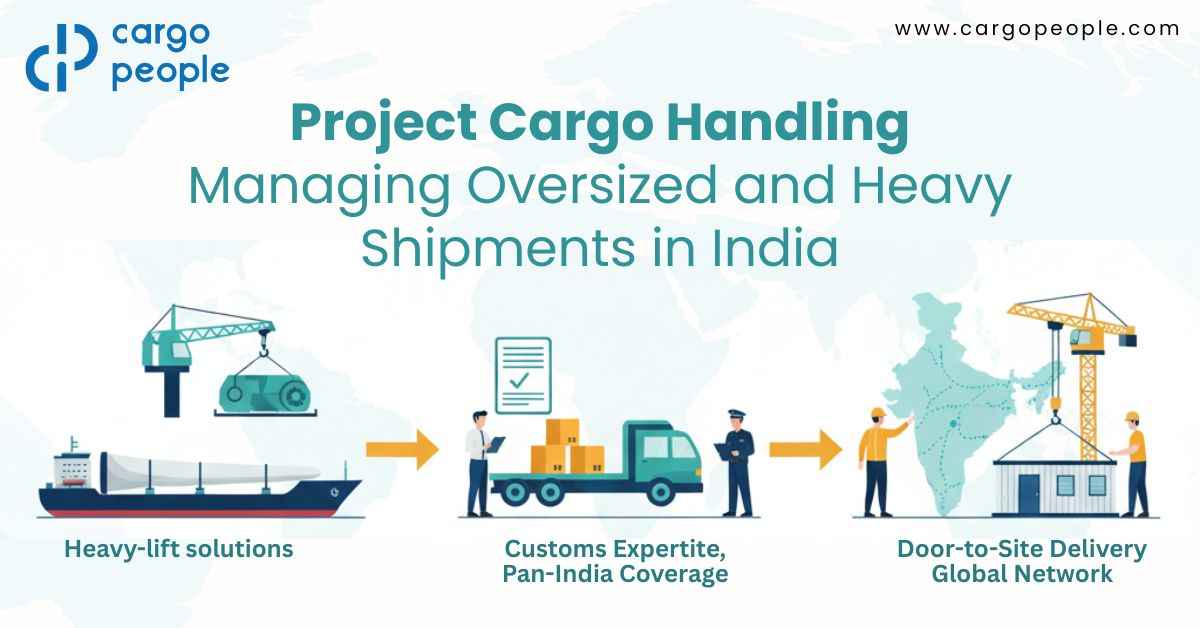
When a 72-Ton Reactor Met a Monsoon: The Reality of Heavy-Lift Shipping
When Maverick Petrochem Ltd., a Gujarat-based engineering company, imported a 72-ton reactor from Germany, they expected a smooth breakbulk routing via Nhava Sheva. But heavy monsoon rains hit Kutch, roads were washed out, and customs flagged the consignment for a Special Valuation Branch (SVB) review.
Truck convoys were halted at the state border, police escorts expired, and port storage charges piled up. The company realized that managing oversized cargo isn’t just about trucks and cranes — it’s about meticulous coordination, paperwork discipline, and proactive route engineering.
That’s where project cargo handling becomes mission-critical — ensuring every ton moves safely, compliantly, and on time, even when nature and bureaucracy throw challenges your way.
What Exactly Is Project Cargo Handling — and Why It Matters
Project cargo handling involves transporting oversized, overweight, or high-value shipments that require special equipment, permits, and coordination between multiple agencies. These shipments often exceed standard shipping container dimensions or axle loads, demanding tailor-made logistics solutions.
Why It’s Crucial for Indian Businesses
-
Regulatory complexity: Indian infrastructure and compliance systems demand special permits, customs approvals, and state coordination.
-
Infrastructure gaps: Bridge load limits, turning radii, and narrow highways require pre-surveyed routing.
-
Cost sensitivity: A single permit delay or misjudged route can lead to ₹5–10 lakh in demurrage or detention fees.
-
Reputation risk: Delayed project components mean missed commissioning dates, penalties, and lost contracts.
For manufacturers, EPCs, or renewable energy developers — precision logistics is as valuable as the cargo itself.
India’s Infrastructure Readiness for Heavy-Lift Logistics
India’s major ports and corridors have rapidly expanded capacity for oversized shipments — especially across the western coastline and industrial hinterlands.
Key Developments Shaping Project Cargo Movement
-
JNPA (Nhava Sheva) has modernized its terminals with deeper drafts and advanced cranes capable of handling breakbulk and ODC shipments.
-
Mundra Port now connects efficiently to inland destinations via double-stack rail and high-capacity highways.
-
Pipavav and Hazira have expanded bulk and breakbulk facilities, reducing dependency on single-gateway ports.
-
The Dedicated Freight Corridor (DFC) allows faster movement of heavy industrial cargo between ports and manufacturing hubs.
What This Means for Shippers
Better port infrastructure translates to:
-
Reduced waiting time for berths and yard space.
-
Higher handling safety for critical equipment.
-
Shorter turnaround cycles, improving working capital efficiency.
The Step-by-Step Framework of Project Cargo Handling
Project cargo success depends on a structured flow — from feasibility analysis to last-mile delivery. Here’s how logistics specialists like Cargo People approach it.
Step 1: Route Survey and Feasibility Analysis
Before the shipment leaves the origin, a comprehensive route survey is conducted in India to identify potential roadblocks — literally and figuratively.
-
Inspect bridges, culverts, and road gradients along the planned route.
-
Assess turning radii and clearance levels for ODC trailers.
-
Identify alternate corridors and backup ports for weather disruptions.
-
Prepare risk maps showing areas requiring police escorts or temporary reinforcements.
This groundwork determines whether the move is even possible — and how much it will cost in permits, equipment, and time.
Step 2: State-Wise Permits and Escorts
Each state in India has its own permit structure for ODC (Over Dimensional Cargo) movement. Without synchronized validity, shipments often get stranded mid-route.
-
Apply for interstate permits covering axle load limits and convoy timings.
-
Coordinate with local police departments for night movement permissions.
-
Validate PWD and NHAI approvals for bridge weight capacity.
-
Keep a permit tracker to monitor expiry windows and renewal deadlines.
When managed proactively, this step prevents multi-day halts and saves lakhs in idle time.
Step 3: Port Operations and Equipment Planning
Ports are not just transfer points — they are operational ecosystems that determine efficiency.
-
Align berth bookings with cargo arrival to avoid demurrage.
-
Confirm availability of heavy-lift cranes, SPMTs, and trailers.
-
Secure dedicated laydown areas for over-dimensional cargo.
-
Plan for customs inspections, fumigation, or repacking if required.
A professional freight forwarder will coordinate between port operators, customs, and ground handlers to ensure seamless offloading and dispatch.
Step 4: Customs Clearance and Compliance
Regulatory navigation is often the trickiest part of the process. Cargo People advises its clients to plan customs documentation as early as shipment planning.
-
SVB (Special Valuation Branch): Required if the supplier is a related company to avoid overvaluation queries.
-
Project Imports Registration: For plant and machinery imports under a single project scheme to reduce duties.
-
EPCG Scheme: To claim duty exemptions on capital goods imported for export-oriented production.
-
Insurance and inspection certificates: To prevent clearance delays due to documentation mismatches.
Having pre-verified documentation ensures cargo release within hours, not days.
Step 5: Multimodal Transport and Delivery
No single mode fits every move. Choosing between sea, air, rail, or road depends on project urgency, geography, and cost targets.
| Mode | Best For | Advantages | Limitations |
|---|---|---|---|
| Sea (Breakbulk / RoRo) | Oversized and indivisible cargo | Economical for long hauls | Slower transit time |
| Rail | Heavy industrial cargo to inland sites | Reliable, cost-effective | Limited siding availability |
| Road (SPMTs / Trailers) | First and last mile | Flexible, direct access | Weather and permit sensitive |
| Air Charter | Critical spares or emergency parts | Fastest transit | High cost and payload limits |
A multimodal plan balances speed, cost, and reliability — optimizing each leg of the journey.
Real-World Risk: The Price of Poor Planning
A renewable energy firm once imported wind turbine components worth ₹40 crore without aligning customs clearance and state escort timings.
Result:
-
Trucks waited 10 days in the port yard.
-
Customs clearance delayed due to document mismatch.
-
₹9 lakh in demurrage and ₹2 lakh in police re-permit fees.
Such operational breakdowns are common when project cargo is treated like a regular shipment. Early feasibility planning, unified permits, and experienced forwarding partners make all the difference.
Two Quick Success Stories
1. Maverick Petrochem Ltd. (Gujarat): By shifting their route from Nhava Sheva to Mundra during monsoon congestion, and coordinating permits through a single logistics partner, they saved nearly ₹7 lakh in yard rent and escort renewals.
2. Orion Wind Systems (Tamil Nadu): Using rail transport for tower sections and only air charter for turbine controllers, the company reduced logistics costs by 12% while meeting commissioning deadlines.
These examples highlight how smart mode-mixing and proactive compliance can turn logistics into a competitive advantage.
Why Partner with Cargo People for Project Cargo Handling
Cargo People offers end-to-end project logistics management, combining on-ground expertise, compliance precision, and engineering-based planning.
-
Pre-move surveys and feasibility studies across India’s industrial belts.
-
Customs compliance desk for SVB, EPCG, and Project Imports documentation.
-
Multimodal planning with sea, rail, and last-mile integration.
-
24×7 tracking and milestone reporting for complete visibility.
-
Safety-first handling of critical, heavy, or high-value cargo.
With Cargo People, businesses move beyond freight forwarding — they gain a logistics partner that plans like an engineer and executes like a consultant.
FAQs on Project Cargo Handling
1. What is project cargo handling in India?
It’s the end-to-end management of oversized and heavy shipments, covering permits, customs, transport engineering, and delivery.
2. Which Indian ports are best for heavy-lift cargo?
JNPA (Nhava Sheva), Mundra, and Pipavav are top choices due to their deep berths, advanced cranes, and highway connectivity.
3. When is air charter recommended?
Only for time-critical spares or plant equipment where delays impact production.
4. How can I avoid demurrage and detention charges?
Pre-register with customs, verify permit validity, and align convoy timing with vessel berthing.
5. What’s the main challenge in project cargo movement?
Regulatory coordination — every delay in escort or customs approval can disrupt the schedule.
Conclusion: Move Big, Move Smart
Project cargo handling is not just transportation — it’s strategic coordination. In India’s complex logistics ecosystem, success lies in early planning, multi-modal design, and regulatory clarity.
Ignoring these can cost millions in lost time and penalties. Partnering with an expert like Cargo People Logistics & Shipping Pvt. Ltd. ensures every move — from documentation to delivery — happens on time, on budget, and on spec.
📞 +91 78350 06245 | 📧 Cha@cargopeople.com
Book a Consultation with Cargo People Logistics