

 USA
USA
 United Kingdom
 Germany
 Argentina
 Australia
 Canada
 New Zealand
Rajesh runs a mid-sized pharmaceutical export business in Hyderabad. His team booked an urgent air shipment to Germany—temperature-sensitive medicines meant for a hospital supply chain. The cargo reached the airport on time, documents were uploaded, and buyers were informed.
Then came the unexpected call.
Customs flagged the shipment due to a missing declaration detail. The cargo sat idle for two days. Storage charges increased, buyers became anxious, and Rajesh spent more time chasing updates than running his business.
Air freight is fast—but customs clearance determines whether speed turns into success or stress. This guide breaks down the air cargo customs clearance process in India, in a way business owners can actually use.
What Is Air Cargo Customs Clearance in India?
Air cargo customs clearance is the regulatory process that allows goods to legally enter or exit India through airports. Customs authorities verify shipment value, classification, compliance, and applicable duties before releasing the cargo.
For Indian importers and exporters, this process directly impacts:
-
Delivery timelines to overseas buyers
-
Storage and demurrage costs at airports
-
Legal compliance under Indian trade laws
Unlike sea freight, air cargo operates on tighter timelines. Even a small documentation error can delay shipments meant to move within hours. This makes planning and accuracy far more critical.
Why Air Cargo Clearance Is More Sensitive Than Sea Freight
Many businesses assume air cargo clears automatically because it’s “express.” In reality, air shipments are scrutinized just as carefully—sometimes more.
Air cargo clearance is sensitive because:
-
Cargo values are usually higher
-
Buyers expect faster delivery commitments
-
Storage charges escalate quickly
-
Airlines operate on strict cut-off schedules
A delayed sea container can wait. A delayed air shipment often disrupts production lines, retail launches, or medical supply chains.
Key Authorities Involved in Air Cargo Clearance
Air cargo customs clearance is not handled by a single office. It involves coordination between multiple authorities, each with a specific role.
Customs officers assess valuation, classification, and duties. Trade authorities regulate export-import eligibility. Airport cargo complexes manage physical movement and inspections.
For businesses, this means compliance is not just about paperwork—it’s about alignment between departments. A freight forwarder acts as the bridge, ensuring nothing falls between systems.
Major clearance activity happens at airports like Delhi, Mumbai, Bengaluru, Chennai, and Hyderabad, each with its own operational nuances.
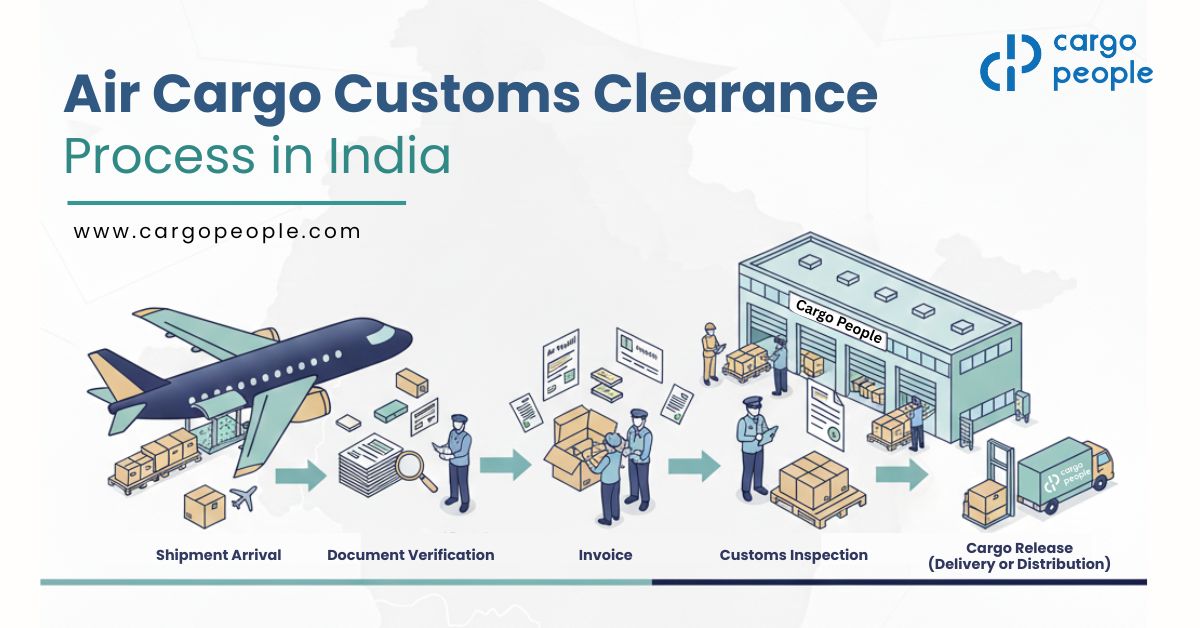
Step-by-Step Air Cargo Customs Clearance Process
Pre-Arrival Planning and Documentation
The clearance process begins well before the cargo arrives at the airport. This is where most delays are either prevented—or created.
At this stage:
-
Shipping bills or bills of entry are filed digitally
-
Cargo value, HS codes, and duty structure are declared
-
Supporting documents are uploaded and cross-verified
Early and accurate filing helps customs process the shipment smoothly and reduces the risk of inspection or reassessment.
Cargo Arrival and Risk Assessment
Once the cargo lands:
-
Customs systems assess the shipment based on risk parameters
-
Some shipments clear directly, while others are flagged for checks
-
Officers review declarations against historical data and trade norms
This stage is heavily influenced by how clean the documentation is. Clear, consistent data often results in faster clearance.
Examination, Duty Payment, and Release
If inspection is required, customs may examine the cargo physically or through scanning. After assessment:
-
Applicable customs duty and taxes are paid
-
Customs issues the final release approval
-
Cargo is handed over for delivery or airline export loading
For businesses, this is the point where every earlier decision shows its impact—either smooth release or costly delay.
Documents Required for Air Cargo Customs Clearance
Documentation is the backbone of air cargo clearance. Even experienced exporters face delays due to small mismatches.
For exports, documents establish cargo value, origin, and eligibility. For imports, they determine duties, compliance, and licensing.
Common issues include:
-
Incorrect HS codes
-
Mismatch between invoice and packing list
-
Missing regulatory declarations
A second-level document review before filing often saves days of follow-up later.
Typical Customs Clearance Timelines for Air Cargo
Air cargo is designed for speed, but timelines depend on preparation and cargo nature.
In most cases:
-
Well-prepared shipments clear within a working day
-
Inspected cargo may take an additional day
-
Regulatory or valuation issues extend timelines unpredictably
For exporters working with overseas buyers, predictability matters more than just speed. Planning clearance timelines builds trust.
Air Freight vs Sea Freight — Business Perspective
Air freight is not a replacement for sea freight—it is a strategic choice.
Businesses use air cargo when:
-
Delivery deadlines are critical
-
Cargo value justifies higher freight cost
-
Market demand is time-sensitive
However, when customs delays occur, air freight becomes disproportionately expensive. The key is choosing air freight with proper compliance planning, not urgency alone.
Common Compliance and Operational Risks
A Delhi-based electronics importer once undervalued cargo to reduce duties. Customs flagged the shipment during assessment.
The result:
-
Cargo detention
-
Financial penalty
-
Loss of buyer confidence
The actual cost far exceeded the duty they tried to save. This is a common pattern—short-term shortcuts often create long-term losses.
Mini Business Story — Smart Clearance Planning
An apparel exporter from Tirupur regularly shipped samples by air. Initially, shipments were booked last-minute with minimal documentation review.
After restructuring their process:
-
Documents were filed in advance
-
Cargo was consolidated smartly
-
Clearance became predictable
They reduced freight spend and eliminated repeated follow-ups. The business didn’t change markets—it changed process discipline.
How a Freight Forwarder Adds Real Value
A freight forwarder is not just a booking agent. In air cargo clearance, they act as:
-
Compliance advisor
-
Documentation controller
-
Liaison with customs and airlines
For business owners, this means fewer surprises, fewer penalties, and fewer late-night calls chasing shipments.
Cargo People focuses on preventive logistics—solving problems before they appear.
Conclusion — Clearance Is a Business Decision, Not a Formality
Air cargo offers speed, but customs clearance determines reliability.
When clearance is planned well:
-
Costs stay under control
-
Buyers receive cargo on time
-
Businesses scale exports with confidence
When ignored, even the fastest flight cannot save the shipment.