

 USA
USA
 United Kingdom
 Germany
 Argentina
 Australia
 Canada
 New Zealand
When Ramesh Gupta, founder of GlobeTrek Exports Pvt. Ltd., received a last-minute apparel order from a European retailer, the excitement turned into stress within hours. The shipment needed to reach Hamburg in just 12 days — a challenge considering sea freight from Chennai Port takes over three weeks.
After consulting his logistics partner, Ramesh switched to air freight consolidation. The move cost more per kilo but guaranteed delivery within a week. His client renewed the order for an entire season — a direct result of a timely freight decision.
That experience taught him a critical lesson:
The right freight choice isn’t about the cheapest rate — it’s about reliability, timing, and understanding business priorities.
Understanding Air Freight and Sea Freight in India
Both air and sea freight are essential to India’s global trade network. The right mode depends on your product’s value, urgency, and logistics budget.
Air Freight (Fast and Premium)
-
Ideal for time-sensitive or high-value goods such as electronics, pharma, and apparel samples.
-
Major air cargo hubs: Delhi, Mumbai, Bengaluru, Chennai, Hyderabad.
-
Regulated by IATA and Indian customs for export/import documentation.
-
Suitable for shipments under 5–10 tonnes, or those needing temperature or security control.
Sea Freight (Economical and Scalable)
-
Best suited for bulky, heavy, or large-volume cargo.
-
Key ports: Mundra, Nhava Sheva (JNPT), Chennai, Kolkata, Hazira, Krishnapatnam.
-
Options include FCL (Full Container Load) and LCL (Less than Container Load).
-
Documentation is more detailed, but cost per unit is significantly lower.
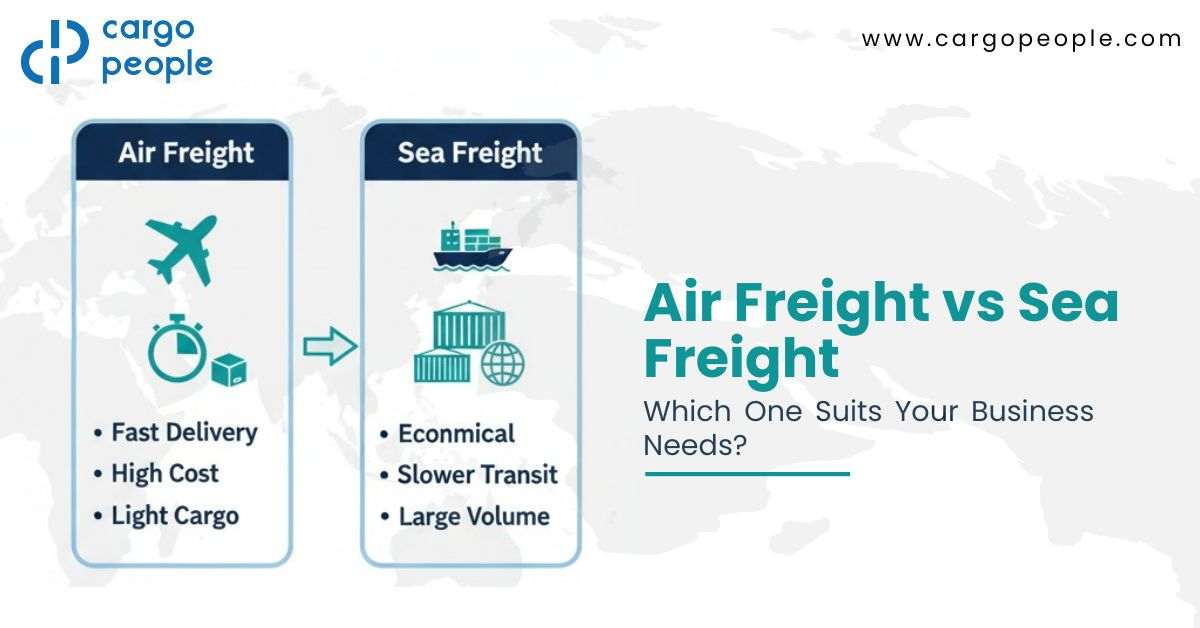
In short, air freight wins on speed, while sea freight dominates on cost efficiency and scalability.
Air Freight vs Sea Freight: Cost, Speed, and Capacity
| Factor | Air Freight | Sea Freight |
|---|---|---|
| Transit Time (India → Europe/US) | 3–7 days | 20–35 days |
| Average Cost | ₹450–₹800 per kg | ₹100–₹150 per kg (FCL equivalent) |
| Cargo Volume | Up to 10 tonnes typical | 1×20ft = 28–30 CBM |
| Reliability | High (daily flights) | Moderate (port delays/weather) |
| Carbon Footprint | 10× higher than sea | Environment-friendly |
| Documentation Complexity | Lower | Higher (BL, manifest, customs) |
Interpretation:
Air freight offers unmatched speed and consistency, while sea freight delivers large-scale cost advantages. Exporters shipping bulk or low-margin goods prefer sea freight. Those handling high-value, time-bound shipments rely on air for predictability.
Factors Every Indian Exporter Should Evaluate
Shipment Value vs Freight Cost
If freight cost exceeds 15–20% of your product’s value, sea freight becomes the logical choice.
For example, a machinery exporter from Pune realized that switching from air to sea saved nearly ₹1.5 lakh per container per shipment cycle.
Delivery Deadlines
In global trade, timing can make or break client trust. For urgent deliveries or product launches, air freight ensures goods arrive exactly when needed.
Industries like fashion, electronics, and pharmaceuticals depend on this reliability.
Cargo Type and Packaging
-
Fragile, perishable, or temperature-sensitive goods — go by air.
-
Heavy or oversized machinery and raw materials — go by sea.
-
Mixed shipments can use both, based on urgency and cost.
Route Connectivity
-
Western ports like Mundra and JNPT connect efficiently to Europe, the Middle East, and Africa.
-
Delhi and Mumbai airports provide direct air cargo routes to 40+ international cities.
Strategic routing helps reduce both cost and time.
Risk and Contingency Planning
-
Sea freight can face port congestion, weather delays, and demurrage.
-
Air freight can face security checks, weight limits, and DG restrictions.
A balanced risk approach often saves money and avoids delays.
India’s Trade Logistics Snapshot (FY 2024–25)
| Major Indian Ports | Container Volume (TEUs) | Annual Growth |
|---|---|---|
| Mundra (Gujarat) | 6.9 million | +7.8% |
| Nhava Sheva (Mumbai) | 5.8 million | +6.2% |
| Chennai Port | 2.2 million | +4.1% |
| Kolkata Port | 1.6 million | +2.9% |
| Hazira & Krishnapatnam | 1.4 million (combined) | +3.7% |
Interpretation:
Sea freight continues to carry about 95% of India’s total trade volume, while air freight contributes significantly to high-value exports — including pharmaceuticals, jewellery, electronics, and precision tools.
This balance makes both modes essential for India’s export growth story.
The Hidden Cost of Non-Compliance
A well-chosen mode of transport can lose its advantage if compliance goes wrong.
Example:
A Delhi-based auto component exporter faced a ₹3.2 lakh penalty when their air consignment was held due to an error in the Importer Exporter Code (IEC) and AD code entry in the shipping bill.
To avoid such issues:
-
Verify IEC, GST, and AD Code details before booking shipments.
-
Match your Invoice, Shipping Bill, and AWB/BL accurately.
-
Track free time for sea containers to avoid detention or demurrage.
-
For air freight, confirm DG classification as per IATA norms.
These checks not only prevent fines but also build a reputation for reliability with customs and buyers.
Sustainability and the Future of Freight
Sustainability is shaping logistics decisions worldwide.
-
Sea freight remains the greener mode, producing significantly lower CO₂ emissions per tonne.
-
Air freight, while faster, is becoming more efficient with modern aircraft and carbon offset programs.
-
Hybrid Sea–Air solutions are emerging, where cargo moves by sea to Dubai or Singapore, then by air to the final destination — saving up to 60% on cost and 40% on time.
India’s National Logistics Policy 2030 and multimodal corridors will encourage this balanced, eco-conscious approach in the coming years.
Real-World Business Lessons
-
Textile Exporter (Tirupur): Switched urgent shipments to air freight, delivered on time, and secured a year-long extension from a European buyer.
-
Engineering Firm (Rajkot): Transitioned from air to sea consolidation, saving nearly ₹2.3 lakh per quarter without affecting delivery schedules.
-
Pharma Company (Hyderabad): Continued using air freight for temperature-controlled shipments, achieving zero rejections overseas.
Each example proves that logistics isn’t just a cost — it’s a strategic business tool that drives customer satisfaction and profitability.
FAQs: Air vs Sea Freight (India)
What’s the average air freight rate from India to Europe?
₹450–₹700 per kg, depending on the destination and season.
How long does sea freight take from India to the USA?
Typically 25–35 days, based on port and trans-shipment routing.
Can I use both air and sea freight for one shipment?
Yes. Sea–Air routes via Dubai or Singapore balance cost and delivery speed effectively.
What documents are required for exports from India?
Commercial Invoice, Packing List, Shipping Bill, Bill of Lading / Airway Bill, Certificate of Origin, and Insurance.
How can I avoid detention or demurrage charges?
Plan clearances early, track container free time, and share BL drafts for verification before sailing.
Conclusion: Choosing Smart, Not Just Cheap
Selecting between air freight and sea freight isn’t a one-time choice — it’s a strategic decision that evolves with your business goals.
-
Choose air freight when delivery time, reliability, and client commitments outweigh cost.
-
Choose sea freight when scaling bulk shipments and optimizing budgets.
-
Combine both modes to build a resilient, flexible, and cost-effective logistics plan.
At Cargo People Logistics, we help Indian businesses make these decisions confidently — blending data insights, compliance expertise, and on-ground coordination to ensure every shipment delivers value.
📞 +91 78350 06245 | 📧 Cha@cargopeople.com
Book a Consultation with Cargo People Logistics