
 USA
USA
 United Kingdom
 Germany
 Argentina
 Australia
 Canada
 New Zealand
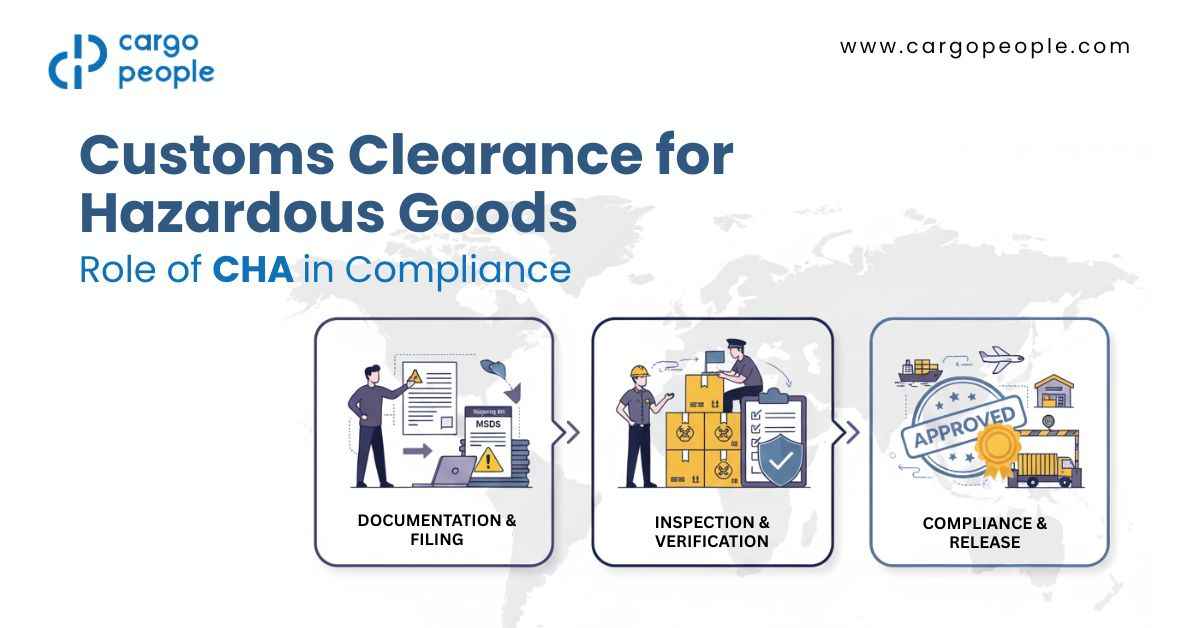
Ravi Mehta, a chemical exporter from Vapi, had always shipped solvents without issues. But in 2025, when India tightened MSDS requirements, his consignment was stopped at Nhava Sheva. The problem was small: an older MSDS version with two missing hazard statements.
Yet that “small problem” created big delays: four days of detention, rising storage charges, an upset buyer, and a shipment dangerously close to cancellation.
A licensed CHA eventually resolved it by updating the MSDS, correcting hazard classification, and coordinating directly with customs. The cargo moved — but the expensive lesson stayed with Ravi.
This is the new reality of hazardous goods clearance in India — stricter, more technical, and far more dependent on compliance accuracy than ever before.
The Rising Complexity of Hazardous Goods Clearance in India
Handling hazardous cargo today involves navigating a maze of regulatory, safety, and documentation standards. Earlier, customs checks were mainly focused on HS code accuracy and basic documentation.
Today, importers and exporters must comply with:
-
Mandatory MSDS submission at the time of customs clearance
-
Stricter alignment with IMDG/IATA codes
-
Hazard classification rules under Indian Chemicals Management & Safety Rules (ICMSR)
-
DGFT conditions for restricted chemicals
-
Port-specific safety protocols
-
Packaging and labeling requirements following GHS standards
Even a minor mismatch in the chemical name, hazard pictogram, or UN number can trigger:
-
Cargo hold
-
Port detention
-
Examination orders
-
Demurrage
-
Re-booking charges
-
In worst cases, re-export
This is why hazardous cargo requires far more than standard customs knowledge. It requires a compliance-driven CHA who understands the entire regulatory ecosystem.
Role of a CHA in Hazardous Goods Clearance — More Than Documentation
A CHA is legally authorized to interact with Indian customs, but for hazardous cargo, their role expands beyond filing documents. They become the guardrail between a smooth clearance and a costly compliance failure.
A skilled CHA supports hazardous cargo clearance through four major responsibilities:
1. Compliance Engineering
Before anything is filed, the CHA examines:
-
MSDS formatting and validity
-
Hazard classification accuracy
-
UN numbers, packing group, and hazard class
-
Whether any DGFT approvals or additional certificates are needed
-
If packaging, labeling, and marking follow global standards
A good CHA doesn’t submit documents — they validate them.
2. Customs Documentation & Filing
Hazardous cargo requires tighter accuracy in:
-
HS code selection
-
Description alignment with MSDS terminology
-
Bill of Entry or Shipping Bill preparation
-
DG declarations
-
Supporting documents like test certificates
Inaccurate filing is the biggest cause of chemical shipment detention in India, and CHAs prevent this upfront.
3. Port Examination & Safety Coordination
Hazardous goods often undergo mandatory examination or safety checks. A CHA handles:
-
Coordinating with customs officers
-
Ensuring safe cargo handling during inspection
-
Resolving any documentation clarifications at the spot
-
Interacting with terminal operators and shipping lines for DG approvals
This stage often determines whether a shipment gets cleared or delayed.
4. Duty Assessment & Final Gate-Out
Once customs gives a green signal, the CHA ensures:
-
Correct duty calculation
-
Claiming eligible exemptions
-
Managing out-of-charge procedures
-
Coordinating with transporters for safe evacuation from the port
This reduces the time hazardous cargo stays within port premises — important because storage charges for DG cargo are significantly higher.
Documentation Required for Hazardous Goods Clearance
Hazardous cargo needs both standard import/export documents and specialized technical documentation. A CHA verifies each document’s completeness.
Essential Documents
-
Commercial Invoice
-
Packing List
-
Bill of Lading / Airway Bill
-
HS Code classification
-
MSDS / SDS (newer than three years and aligned with product details)
-
UN Number and Hazard Class
-
DG Declaration
-
Test Reports (if applicable)
-
Consignee/Importer License (if required by DGFT)
-
Compliance with GHS labeling
A CHA’s internal document checklist ensures no step is overlooked.
Top Ports and Clearance Timelines in India — Hazardous vs General Cargo
| Port | Common Hazardous Cargo | Avg Clearance (General Cargo) | Avg Clearance (Hazardous Cargo) |
|---|---|---|---|
| Nhava Sheva (JNPT) | Solvents, chemicals | 1.5–2 days | 2–4 days |
| Mundra | Petrochemicals, corrosives | 1–1.5 days | 2–3.5 days |
| Chennai | Batteries, paint, lab chemicals | 2–2.5 days | 3–5 days |
| Hazira | Industrial chemicals | 1–1.5 days | 2–3 days |
Interpretation:
Hazardous cargo consistently takes longer due to MSDS scrutiny, safety checks, and DG verification. Experienced CHAs reduce this timeline significantly.
How a CHA Prevents Clearance Delays — Step-By-Step
1. Pre-Shipment Verification
Before cargo even leaves the supplier’s facility, a CHA checks:
-
Correct hazard classification
-
MSDS accuracy
-
Consistency between invoice and MSDS
-
Shipping line requirements for DG booking
-
Any DGFT or ICMSR-related restrictions
This step alone can prevent 80% of clearance problems.
2. Filing & Documentation Accuracy
A CHA prepares the Bill of Entry with special care for:
-
Description alignment
-
Technical names
-
CAS numbers
-
Hazard phrases
-
Labeling details
-
Proper supporting documents
The accuracy here determines whether customs flags the shipment or clears it.
3. Examination Assistance
Hazardous goods often require extra documentation during examination. CHAs answer queries such as:
-
Why the product falls under a certain hazard class
-
Whether the MSDS matches tariff codes
-
How the cargo has been packed
-
Whether the importer is authorized to handle such chemicals
Experienced CHAs handle these clarifications immediately, preventing multi-day holds.
4. Final Clearance
After approval, the CHA handles:
-
Duty payment
-
Out-of-charge formalities
-
Terminal coordination
-
Vehicle entry and exit
-
Safe evacuation timelines
This ensures the cargo leaves the port quickly, avoiding DG storage charges.
Cost Impact of Non-Compliance — Average Across Indian Ports
| Issue | Approximate Cost Impact |
|---|---|
| Wrong MSDS or outdated version | ₹50,000 – ₹1,20,000 |
| Incorrect UN classification | ₹80,000 – ₹2,50,000 |
| DG cargo detention | ₹15,000 – ₹40,000 per day |
| Container detention | ₹5,000 – ₹12,000 per day |
| Re-export due to compliance failure | ₹2–7 lakh |
Interpretation:
Hazardous cargo errors create compounding financial losses. A CHA’s preventive compliance approach saves significant time and cost.
Conclusion — Why Cargo People Is the Right Partner
Hazardous cargo clearance in India today requires technical knowledge, regulatory awareness, and precise documentation. With MSDS rules tightening and ICMSR shaping the chemical landscape, businesses cannot rely on basic customs support.
Cargo People provides:
-
Hazard-specific CHA expertise
-
End-to-end document verification
-
Faster, compliant clearance across major ports
-
Reduction in demurrage and detention
-
Safe and accurate handling throughout the process
This is the difference between a delayed shipment and a perfectly executed one.
CTA — Talk to Hazardous Cargo Experts Today
📞 +91 78350 06245
📩 Cha@cargopeople.com