

 USA
USA
 United Kingdom
 Germany
 Argentina
 Australia
 Canada
 New Zealand
Importing goods into India can look straightforward on paper. But for many businesses, the real challenge begins when a shipment reaches the port and customs duties, taxes, or HS code issues suddenly delay clearance.
A Delhi-based electronics importer recently faced this exact situation. His cargo arrived at Nhava Sheva on time, documents were in place, but a minor HS code mismatch led to reassessment. The result? Four extra days at port, unexpected duty demand, and demurrage costs that wiped out his profit margin on the shipment.
This is why understanding customs duty India, HS code classification, and import tariffs isn’t just a compliance task — it’s a business survival skill.
Understanding Customs Duties in India
Customs duty is a tax levied by the Indian government on goods imported into the country. Its purpose is not only revenue generation but also protection of domestic industries and regulation of trade.
For importers, customs duties directly affect:
-
Landed cost of goods
-
Pricing strategy in the Indian market
-
Profit margins and cash flow planning
A clear understanding of duty structure helps businesses avoid surprises at the port and plan imports more strategically.
Components of Customs Duty Structure in India
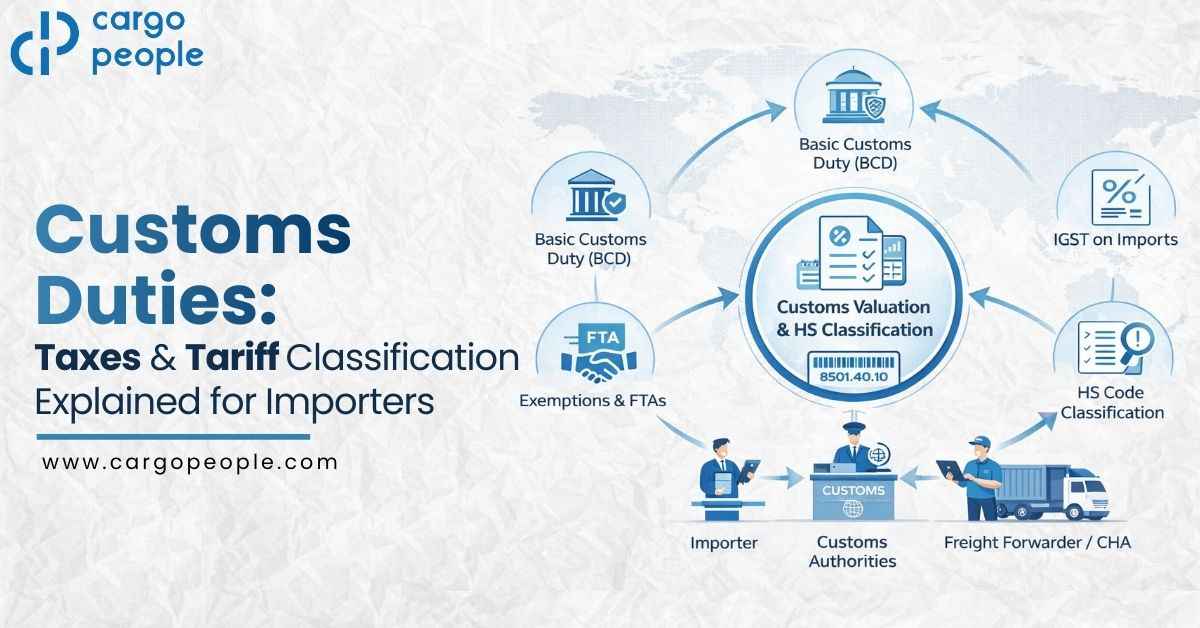
India’s customs duty is not a single tax. It consists of multiple components that together determine the final duty payable.
Key components include:
-
Basic Customs Duty (BCD): The core duty applied to imported goods
-
Social Welfare Surcharge (SWS): Calculated as a percentage of BCD
-
Integrated GST (IGST): Applied on the assessable value plus customs duty
-
Compensation Cess: Applicable on select products such as automobiles or luxury goods
Many importers underestimate how these layers compound, increasing the total duty burden beyond initial expectations.
What Is HS Code Classification and Why It Matters
HS (Harmonized System) codes are internationally standardized product classification codes used to determine applicable customs duties and taxes.
In India, HS code classification is critical because it decides:
-
Duty rates
-
Import policy conditions
-
Licensing or restriction requirements
A single digit error in HS code selection can change duty rates drastically or trigger compliance scrutiny.
Common HS Code Classification Mistakes Importers Make
HS classification errors are among the most frequent causes of customs delays in India.
Typical mistakes include:
-
Choosing a generic HS code instead of a product-specific one
-
Relying solely on supplier-provided HS codes
-
Ignoring explanatory notes and Indian tariff interpretations
-
Using outdated HS codes after annual tariff updates
These errors often surface only after the shipment arrives, when correction becomes costly and time-consuming.
Customs Duty Calculation: How It Works in Practice
Customs duty is calculated on the assessable value, usually derived from the CIF value (Cost + Insurance + Freight).
Below is a simplified illustration:
| Duty Component | Basis of Calculation |
|---|---|
| Assessable Value | CIF value of goods |
| Basic Customs Duty | % of assessable value |
| Social Welfare Surcharge | % of BCD |
| IGST | Applied on total of AV + BCD + SWS |
What this means for importers:
Even a small increase in freight or insurance can raise the total duty payable. This makes freight planning and documentation accuracy extremely important.
Average Customs Clearance Timelines at Major Indian Ports
| Port | Average Clearance Time |
|---|---|
| Nhava Sheva (JNPT) | 2–4 days |
| Mundra | 2–3 days |
| Chennai | 3–5 days |
| Kolkata | 4–6 days |
Interpretation:
Most delays beyond these timelines are caused by documentation errors, HS code disputes, or valuation queries — not port congestion alone.
Real-World Compliance Risk: What Can Go Wrong
An auto components importer in Pune declared goods under a lower-duty HS code based on supplier advice. During customs examination, authorities reclassified the product, imposed differential duty, interest, and a penalty. The container remained detained for a week, adding heavy demurrage costs.
What went wrong:
-
No pre-shipment HS code validation
-
No customs advisory support
-
Duty planning done after cargo arrival
Proactive classification review could have prevented the issue entirely.
How Importers Can Legally Reduce Customs Duty
Reducing customs duty does not mean cutting corners. It means planning imports smartly and compliantly.
Effective strategies include:
-
Correct HS code selection using explanatory notes
-
Exploring Free Trade Agreements (FTAs) eligibility
-
Leveraging duty exemption notifications
-
Optimizing shipment value and freight structure
These steps require coordination between importers, customs brokers, and freight forwarders — not last-minute fixes.
The Role of Freight Forwarders in Tariff & Duty Planning
A professional freight forwarder does more than move cargo. They help importers:
-
Validate HS codes before shipment
-
Estimate landed cost accurately
-
Prepare customs-ready documentation
-
Coordinate with customs authorities during clearance
This integrated approach reduces clearance delays and prevents unplanned duty exposure.
Mini Business Story: Duty Savings Through Correct Classification
A machinery importer in Ahmedabad was paying higher customs duty due to an incorrectly used HS code. After a pre-shipment review, the product was reclassified under the correct tariff heading.
The result:
-
Lower applicable duty rate
-
Savings of over ₹3.2 lakh on a single shipment
-
Faster customs clearance at Mundra Port
Small classification decisions can create big financial impact.
Why Ignoring Tariff Planning Is a Costly Mistake
When importers treat customs duty as a post-arrival formality, they expose their business to:
-
Unexpected duty demands
-
Shipment detention
-
Penalties and interest
-
Loss of customer trust due to delivery delays
Customs compliance should begin before goods are shipped — not after they land.
How Cargo People Helps Importers Stay Compliant & Cost-Efficient
Cargo People Logistics works closely with Indian importers to:
-
Review HS code classification before shipment
-
Estimate accurate landed cost
-
Coordinate customs clearance smoothly
-
Minimize duty risks and demurrage
Our consultative approach ensures your shipments move faster, smarter, and with full regulatory confidence.
Conclusion: Customs Knowledge Is a Competitive Advantage
Customs duties, taxes, and tariff classification are not just regulatory obligations — they directly impact your profitability and delivery timelines.
By understanding duty structures, choosing correct HS codes, and planning imports proactively, Indian businesses can:
-
Avoid shipment delays
-
Reduce customs duty exposure
-
Improve supply chain reliability
With the right logistics partner, customs compliance becomes a strategic advantage — not a recurring headache.
Talk to Cargo People – Your Customs & Logistics Partner
📞 +91 9717465454
📧 wecare@cargopeople.com
Book a Consultation with Cargo People Logistics