

 United Kingdom
 Germany
 Argentina
 Australia
 Canada
 New Zealand
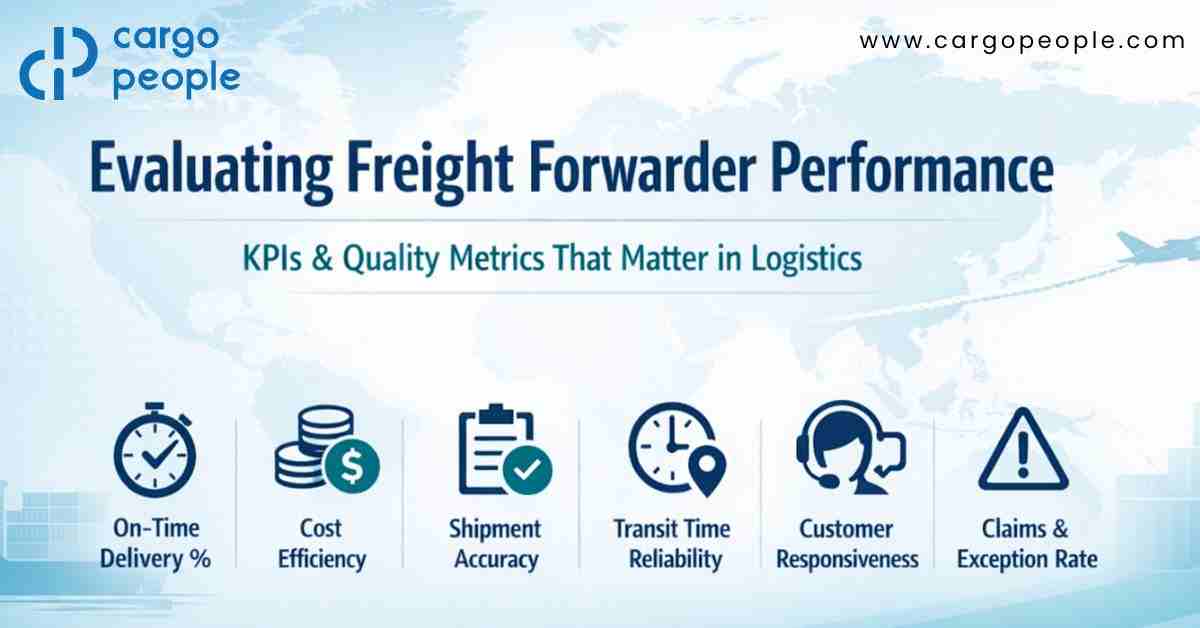
For many Indian importers and exporters, freight forwarding runs on long-term relationships and trust. Shipments move, invoices are paid, and operations continue — until something goes wrong.
A Pune-based engineering exporter learned this the hard way when one export container was delayed at Nhava Sheva due to a documentation mismatch. The delay resulted in demurrage charges, missed delivery commitments, and repeated follow-ups from the overseas buyer. When the exporter tried to identify the root cause, there was no clear answer — because the freight forwarder’s performance had never been evaluated.
This is why measuring freight forwarder performance using clear KPIs and quality metrics is no longer optional. It is a business necessity.
Why Evaluating Freight Forwarder Performance Is Critical
Freight forwarding impacts much more than transportation. It directly affects delivery timelines, landed costs, regulatory compliance, and customer confidence.
In the Indian logistics environment, even small inefficiencies can escalate quickly due to port congestion, customs examinations, regulatory changes, and volatile freight rates. Without performance measurement, businesses often react only after costs have already been incurred.
Evaluating freight forwarder performance allows importers and exporters to move from reactive problem-solving to structured control over their logistics operations.
On-Time Delivery Performance
On-time delivery is one of the most visible indicators of freight forwarder reliability. However, many businesses rely on verbal commitments rather than actual performance data.
Transit delays may occur due to port congestion, carrier rollovers, or poor planning. When delays happen repeatedly, they disrupt production schedules, buyer commitments, and cash flow.
Key aspects to evaluate include actual transit time versus committed transit time, consistency across multiple shipments, and performance on critical trade lanes such as India–USA and India–Europe.
Reliable delivery performance reduces uncertainty, avoids expediting costs, and strengthens credibility with overseas customers.
Customs Clearance Efficiency
Customs clearance is one of the most sensitive performance areas in Indian logistics. A freight forwarder’s operational strength becomes most visible during customs handling.
Delays are often caused by documentation errors, late submissions, or weak coordination rather than customs procedures themselves. Even a small error can lead to examination, detention, or penalties.
Businesses should assess documentation accuracy, average clearance turnaround time, and the frequency of customs queries. Strong customs performance helps avoid cargo detention, penalties, and unnecessary storage charges at ports and ICDs.
Cost Accuracy and Freight Rate Reliability
Freight costs rarely become an issue at the quotation stage. Problems usually surface in the final invoice.
Unexpected surcharges, frequent rate revisions, or unclear explanations often indicate weak cost control. Over time, these discrepancies erode profit margins and complicate budgeting.
Important indicators include the difference between quoted and billed freight costs, transparency in surcharge communication, and consistency of rates across similar shipments.
Accurate and predictable freight costing allows businesses to maintain better control over landed costs and pricing commitments.
SLA Compliance in Logistics Operations
Service Level Agreements define expectations, but their value lies in enforcement. Many SLAs are signed and forgotten, leaving no accountability when service levels drop.
SLA compliance should be measured across documentation timelines, transit commitments, and responsiveness during disruptions. A freight forwarder that consistently meets SLAs usually operates with better internal systems and clearer ownership.
Monitoring SLA adherence helps businesses hold partners accountable and improve service consistency over time.
Exception Management and Communication Quality
Delays, inspections, and port congestion are part of international trade. What differentiates a reliable freight forwarder is how they respond during exceptions.
Poor communication increases stress, delays decision-making, and damages buyer confidence. Proactive communication, on the other hand, helps businesses plan alternatives and manage expectations.
Businesses should evaluate response time during disruptions, clarity of explanations, and the ability to propose corrective actions. Strong exception management protects business continuity even when shipments face challenges.
Freight Damage Control and Claims Handling
Cargo damage or loss directly affects revenue and customer trust. A capable freight forwarder does not disappear when a claim arises.
Performance in this area can be measured through the frequency of damage incidents, the time taken to initiate and resolve claims, and the quality of documentation support provided during the claims process.
Efficient claims handling minimizes financial exposure and reduces the administrative burden on importers and exporters.
Logistics Performance Benchmarks in India
Understanding performance benchmarks helps businesses identify when delays or issues are abnormal.
Average Customs Clearance Timelines
| Cargo Mode | Typical Clearance Time |
|---|---|
| Air Freight | 1–2 working days |
| Sea Freight (FCL) | 3–4 working days |
| Sea Freight (LCL) | 4–6 working days |
If shipments consistently exceed these timelines, it often points to documentation gaps or coordination failures rather than port inefficiency.
Major Indian Ports by Container Throughput
| Port | Approximate Annual Throughput |
|---|---|
| Nhava Sheva (JNPT) | 6+ million TEUs |
| Mundra | 6+ million TEUs |
| Chennai | 5+ million TEUs |
| Kolkata | 0.8+ million TEUs |
Freight forwarders with strong operational presence at high-volume ports typically demonstrate better process control and coordination.
Real-World Compliance Risk Example
A Delhi-based electronics importer faced detention and demurrage charges at Mundra port due to incorrect product classification in customs documentation.
The freight forwarder failed to respond promptly to a customs query, resulting in a seven-day delay. The total financial impact exceeded ₹3.8 lakh, along with strained supplier relationships.
This incident highlights how weak documentation control and poor follow-up can directly damage cash flow and business credibility.
Mini Business Story: KPI-Driven Savings
An apparel exporter from Tirupur regularly shipped to Europe using air freight due to tight buyer deadlines. Despite higher costs, delays were still frequent.
By reviewing transit-time variance and delivery reliability, the exporter shifted part of the volume to a consolidation-based routing model. This change reduced freight costs by approximately ₹2.5 lakh annually while improving delivery consistency.
KPIs transformed logistics decisions from assumption-based to data-driven.
How to Build a Freight Forwarder Performance Scorecard
Evaluating freight forwarders does not require complex dashboards. A simple monthly scorecard covering on-time delivery, clearance turnaround, cost deviation, SLA compliance, and exception resolution is enough to identify performance trends.
Quarterly reviews help businesses reallocate volumes, renegotiate contracts, and strengthen partnerships with reliable forwarders.
Conclusion: Why Performance Measurement Matters
Freight forwarding performance cannot be managed on trust alone. Without clear KPIs, inefficiencies remain hidden until they become expensive.
By tracking logistics KPIs in India, businesses can reduce demurrage costs, avoid shipment delays, improve compliance, and strengthen relationships with overseas buyers.
At Cargo People Logistics, performance measurement is built into every shipment. Our focus on transparency, accountability, and proactive planning helps businesses turn logistics into a strategic advantage.
📞 +91 9717465454 | 📧 wecare@cargopeople.com
Book a Consultation with Cargo People Logistics
FAQs
What are key logistics KPIs in India?
On-time delivery, customs clearance time, cost accuracy, SLA compliance, and exception handling.
How do SLAs help in freight forwarding?
They define service expectations and allow businesses to measure and enforce performance.
Why do shipments get delayed at Indian ports?
Common reasons include documentation errors, customs queries, and coordination gaps.
How can importers reduce demurrage costs?
By working with KPI-driven freight forwarders and monitoring clearance timelines.
What makes a good freight forwarder in India?
Strong customs expertise, transparent pricing, consistent communication, and measurable performance.