

 United Kingdom
 Germany
 Argentina
 Australia
 Canada
 New Zealand
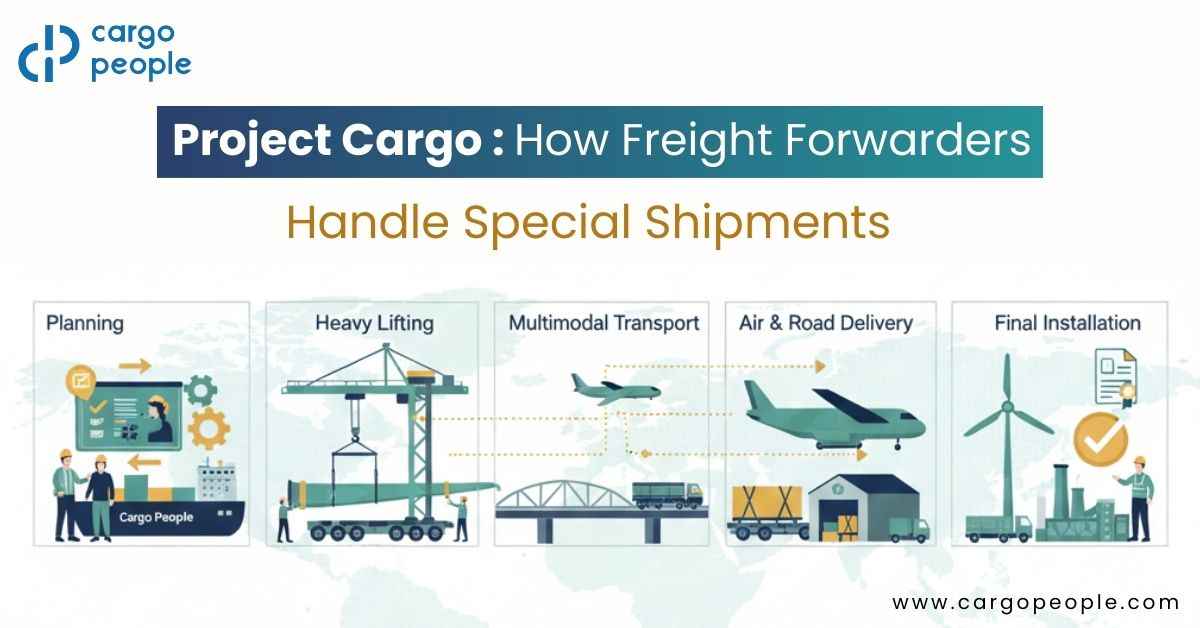
When a power equipment manufacturer in Gujarat imported a 96-ton turbine from Germany, everything looked planned on paper. The vessel arrived on time at Mundra Port. But the cargo didn’t move for six extra days.
The reason? A missing route approval for an overhead power line clearance on the highway.
That delay alone added ₹4.8 lakh in demurrage and crane idle charges.
Project cargo doesn’t fail because of size alone. It fails when planning, permits, and execution don’t move in sync. This is where experienced freight forwarders make the difference.
What Is Project Cargo in Practical Terms?
Project cargo refers to large, heavy, or high-value equipment shipped as part of a single industrial or infrastructure project. These shipments are time-bound, often indivisible, and usually involve multiple transport modes.
Unlike standard cargo, project cargo:
-
Cannot be containerized easily
-
Requires pre-engineered lifting and route planning
-
Must comply with port, customs, road, and safety regulations simultaneously
For Indian businesses in sectors like power, steel, oil & gas, renewable energy, and heavy engineering, project cargo is not optional—it’s mission-critical.
Why Project Cargo Needs a Specialized Freight Forwarder
Handling project cargo isn’t about booking freight. It’s about orchestrating multiple approvals, vendors, and risks into one controlled execution plan.
An experienced freight forwarder acts as:
-
A logistics architect
-
A compliance manager
-
A risk mitigator
-
A single point of accountability
This coordination becomes even more critical in India, where port infrastructure, road conditions, and state-wise permissions vary widely.
How Freight Forwarders Plan Project Cargo Shipments
Every successful project cargo movement begins long before the cargo is lifted.
Pre-Shipment Engineering & Feasibility
Freight forwarders first evaluate:
-
Cargo dimensions, weight, center of gravity
-
Disassembly feasibility (if any)
-
Required cranes, trailers, and vessels
-
Port handling capabilities
This stage decides whether sea, air, road, rail—or a combination—makes commercial sense.
Choosing the Right Indian Port for Project Cargo
Not all ports are equally equipped for oversized or heavy-lift cargo. Selection depends on crane capacity, berth strength, storage space, and hinterland connectivity.
Major Indian Ports Handling Project Cargo
| Port | Strength for Project Cargo | Typical Industries Served |
|---|---|---|
| Mundra | Heavy-lift cranes, deep draft, private efficiency | Power, Oil & Gas, Renewables |
| Nhava Sheva (JNPA) | Strong customs ecosystem, connectivity | Engineering, Machinery |
| Kandla (Deendayal) | Bulk & ODC handling | Steel, Infrastructure |
| Chennai | Breakbulk & industrial cargo | Manufacturing, Auto |
| Vizag | Project and bulk cargo | Mining, Power |
What this means for businesses:
Choosing the wrong port can increase inland transport cost by 20–30% and add avoidable clearance delays.
Multimodal Transport Strategy for Special Shipments
Project cargo rarely moves through a single mode.
Freight forwarders design multimodal routes such as:
-
Vessel → Port crane → Hydraulic trailer → Night road convoy
-
Vessel → Rail siding → Factory gate
-
Charter aircraft → specialized road transfer
Cost & Risk Comparison by Mode
| Mode | Relative Cost | Speed | Risk Profile | Best Used When |
|---|---|---|---|---|
| Sea Freight | Low | Slow | Weather, port congestion | Heavy & oversized cargo |
| Air Freight | Very High | Fast | Handling sensitivity | Critical shutdown parts |
| Road (ODC) | Medium | Medium | Route, permits, escorts | Final delivery |
| Rail | Low–Medium | Medium | Limited routes | Long-distance inland |
Business takeaway:
A well-planned multimodal route can save ₹10–15 lakh per shipment versus ad-hoc decision-making.
Customs Clearance for Project Cargo in India
Customs clearance is where many project shipments stall.
Freight forwarders ensure:
-
Correct HS classification (avoids duty disputes)
-
Advance filing of Bill of Entry
-
Coordination with Customs, Port Trust, and terminal operators
-
Alignment with DGFT and CBIC requirements
Even a minor mismatch in invoice value or cargo description can trigger physical examination and detention.
ODC & Route Survey Planning — The Hidden Risk Layer
Oversized Cargo (ODC) movement requires route surveys before the shipment even arrives.
Freight forwarders assess:
-
Bridge load capacity
-
Road width and turning radius
-
Overhead cables and signage
-
State-wise transport permits
-
Police and utility escorts
Common Approval Bottlenecks
-
State border permit delays
-
Local authority clearance for cable lifting
-
Night movement restrictions
Ignoring route surveys is one of the costliest mistakes in project logistics.
A Real Operational Risk Example
A wind energy project in Rajasthan imported tower sections through a non-specialized forwarder. The cargo reached port on time, but:
-
Route survey was incomplete
-
State PWD approval was delayed
-
Storage charges accumulated
Impact:
-
9-day delay
-
₹6.2 lakh additional cost
-
Project commissioning pushed by two weeks
A proactive freight forwarder would have aligned port discharge, route permits, and convoy scheduling well in advance.
Why Businesses Rely on Cargo People for Project Cargo
Cargo People specializes in end-to-end project cargo forwarding, combining:
-
India port expertise
-
ODC and heavy-lift planning
-
Customs and compliance management
-
Cost-optimized multimodal execution
The focus isn’t just movement—it’s predictability, control, and accountability.
Conclusion — Project Cargo Is Planning, Not Just Transport
Project cargo success depends on:
-
Early engineering and feasibility checks
-
India-specific port and route planning
-
Strong customs and compliance control
-
A freight forwarder who thinks like a project manager
Ignoring these elements risks delays, penalties, and reputational damage.
📞 +91 78350 06245 | 📧 wecare@cargopeople.com
Book a Consultation with Cargo People Logistics