

 USA
USA
 United Kingdom
 Germany
 Argentina
 Australia
 Canada
 New Zealand
A Mumbai-based medical equipment importer once had a life-saving diagnostic machine worth ₹1.4 crore stuck at CSMIA for 72 hours. The reason was not congestion. It was a minor mismatch between the HS code declared and the product description on the invoice.
Air freight moved the shipment from Germany in less than 48 hours. Customs clearance took longer than the flight itself. Storage charges started at ₹9–₹12 per kg per day, and the hospital installation deadline was pushed back.
Air freight is fast. Customs clearance must be faster. If you are importing or exporting through Chhatrapati Shivaji Maharaj International Airport (CSMIA), Mumbai, understanding the express clearance process can save time, cost, and compliance risk.
Why Mumbai Airport Is a Strategic Air Cargo Gateway for Indian Businesses
Mumbai is not just a metro city airport. It is one of India’s top air cargo hubs handling high-value, time-sensitive goods. For industries like pharmaceuticals, electronics, auto components, engineering goods, and garments, CSMIA plays a critical role in global supply chains.
India’s total air cargo volume has crossed approximately 3.5–3.7 million metric tonnes annually, with Mumbai contributing a significant share. On peak days, thousands of tonnes of cargo move through its terminals.
What Makes CSMIA Critical for Importers and Exporters
Before understanding customs clearance, it’s important to understand why shipments route through Mumbai:
-
Serves major trade corridors: India–USA, India–Germany, India–UAE, India–China
-
Handles temperature-controlled pharma cargo in large volumes
-
Multiple cargo terminal operators: AISATS, Celebi, AAICLAS
-
High flight frequency to over 50+ international destinations
-
Strong connectivity to Maharashtra, Gujarat, and Central India industrial belts
For businesses shipping urgent consignments worth ₹50 lakh to ₹5 crore, even a 24-hour delay can impact production cycles, working capital, and buyer commitments.
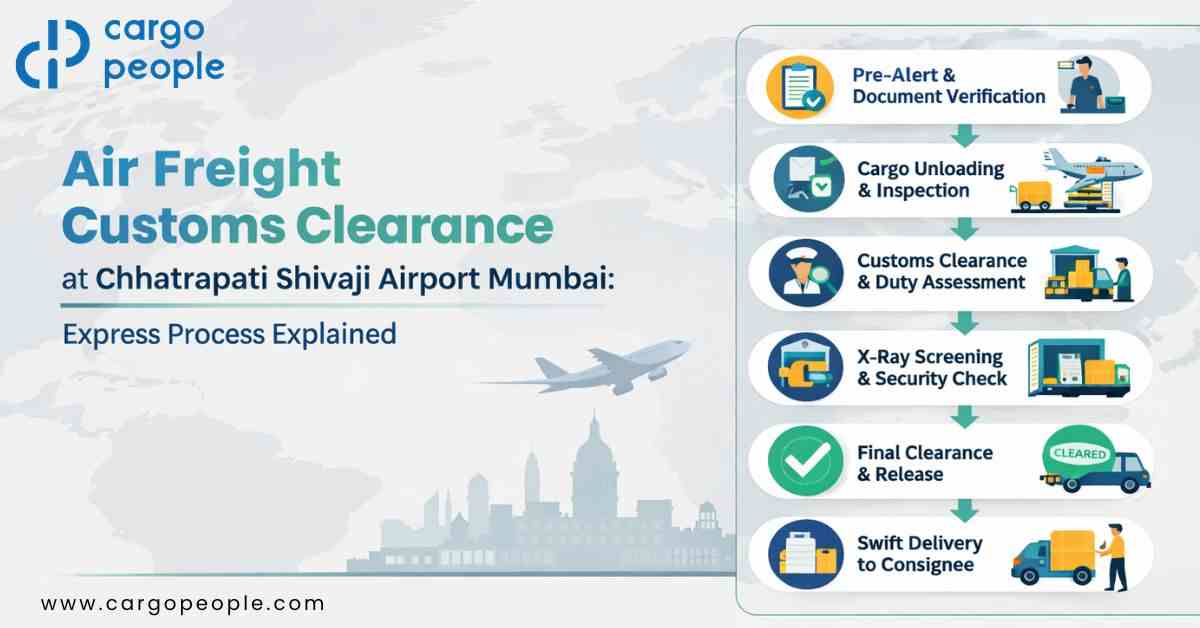
Step-by-Step Air Freight Customs Clearance Process at CSMIA
Many businesses assume customs clearance starts after cargo lands. In reality, clearance efficiency begins at least 24–48 hours before aircraft arrival.
Pre-Arrival Documentation and Filing
This is where most delays originate. Proper pre-filing can reduce clearance time by up to 40%.
Essential documents include:
-
Commercial Invoice (accurate valuation in foreign currency)
-
Packing List (net weight, gross weight, package count)
-
Airway Bill (MAWB/HAWB)
-
Importer Exporter Code (IEC)
-
GST details
-
Correct HS Code (8-digit classification)
-
Product-specific licenses if required
Filing the Bill of Entry through ICEGATE before cargo arrival allows the system to process risk assessment early. Businesses that pre-file often clear cargo within 24–36 hours instead of 72 hours.
Cargo Arrival and Terminal Handling
Once the aircraft lands:
-
Cargo is moved to the assigned terminal
-
AWB data is verified in the system
-
Bill of Entry is linked to the shipment
-
Risk Management System (RMS) assigns clearance channel
There are typically 3 assessment routes:
-
Facilitation (no examination)
-
Document check
-
Physical examination
If RMS grants facilitation, shipments can move to duty payment stage immediately.
Assessment and Duty Calculation
Customs verifies:
-
HS code classification
-
Assessable value
-
Basic Customs Duty (varies 0%–20% depending on product)
-
IGST (usually 18% or 28% depending on category)
-
Social Welfare Surcharge (10% of BCD)
A 5% valuation error on a ₹80 lakh shipment can create a differential duty demand of ₹4–₹6 lakh plus penalties. This is why pre-shipment compliance review matters.
Examination and Regulatory Approvals
If the shipment is flagged:
-
Physical cargo inspection is conducted
-
Samples may be drawn (pharma, chemicals, food items)
-
Additional regulatory clearance may be required
For example:
-
CDSCO for medical devices
-
FSSAI for food products
-
BIS certification for electronics
Such cases can increase clearance time from 48 hours to 4–7 days if documentation is incomplete.
Out of Charge and Delivery
After successful assessment:
-
Duty is paid online
-
“Out of Charge” order is granted
-
Delivery order issued by airline/terminal
-
Cargo can be picked up or moved for door delivery
Efficient coordination at this stage can reduce additional terminal storage charges.
Express Customs Clearance at Mumbai Airport — What It Really Means
Express clearance is not about bypassing rules. It is about compliance discipline.
When systems and documents are aligned correctly, clearance becomes fast.
Key Factors That Enable 24–36 Hour Clearance
-
Advance Bill of Entry filing
-
Accurate HS classification with no ambiguity
-
Transparent valuation with supplier documents
-
No license mismatch
-
Immediate duty payment
-
CHA presence at terminal for real-time coordination
Businesses following structured processes often reduce average clearance time by 30%–50%.
Without preparation, clearance can stretch to 72–96 hours.
Average Clearance Timelines for Different Cargo Types
| Cargo Category | Standard Clearance | Express Clearance |
|---|---|---|
| General Goods | 48–72 hours | 24–36 hours |
| Pharmaceuticals | 72–96 hours | 36–48 hours |
| Electronics (High Value) | 3–4 days | 36–48 hours |
| Restricted Goods | 4–7 days | Case dependent |
For high-value imports worth ₹1 crore, even 2 extra days can block working capital and increase indirect costs.
Financial Impact of Delayed Clearance
Many businesses underestimate the financial side of customs delay.
Typical additional costs include:
-
Terminal storage: ₹8–₹15 per kg per day
-
Airline demurrage after free period
-
Customs penalty (if misdeclaration found)
-
Production stoppage losses
-
Buyer penalty clauses
A mid-sized electronics importer once faced:
-
6-day detention
-
₹1.8 lakh storage charges
-
₹3.2 lakh differential duty demand
-
Shipment delivery delay to OEM client
Total impact crossed ₹5 lakh for a documentation error.
Real Compliance Risk Example
An importer declared a component under an incorrect HS code with 5% duty instead of the applicable 15%.
Customs reassessed:
-
Additional duty demand raised
-
100% penalty imposed under applicable provisions
-
Cargo detained for examination
-
Business credibility affected
The importer later implemented pre-import documentation audits to avoid repetition.
The lesson is simple: speed without compliance leads to cost escalation.
Mini Business Story — Faster Clearance, Stronger Buyer Confidence
A Mumbai-based auto component exporter was shipping urgent parts to the United States every week.
Earlier challenges:
-
2–3 days clearance delay
-
Manual documentation corrections
-
Frequent RMS examination
After implementing structured documentation review and advance filing:
-
Clearance reduced to 30–36 hours
-
Zero penalty notices in 12 months
-
Saved approximately ₹2.4 lakh annually in avoidable storage
-
Improved on-time delivery performance to 98%
Small operational improvements strengthened global buyer relationships.
How Freight Forwarders Improve Customs Efficiency
A professional freight forwarder does more than coordinate flights.
They help businesses:
-
Classify HS codes correctly
-
File advance Bill of Entry
-
Calculate accurate duty exposure
-
Coordinate with regulatory agencies
-
Track shipments in real-time
-
Arrange bonded trucking if required
-
Manage door-to-door delivery
For shipments valued above ₹50 lakh, expert coordination reduces financial and compliance risk significantly.
Why Businesses Trust Cargo People for Mumbai Air Freight Clearance
Cargo People combines operational presence with compliance expertise.
Our approach includes:
-
Pre-shipment documentation verification
-
Express ICEGATE filing support
-
Duty planning and advisory
-
Regulatory coordination (DGFT and Customs compliance)
-
Terminal-level coordination at AISATS and Celebi
-
Door-to-door delivery integration
For urgent cargo, structured planning reduces risk, cost, and delays.
Conclusion
Air Freight Customs Clearance at Chhatrapati Shivaji Airport Mumbai is not complicated — but it demands precision.
Businesses that plan ahead:
-
Reduce demurrage costs
-
Avoid shipment delays
-
Prevent customs penalties
-
Protect working capital
-
Improve delivery reliability
Ignoring documentation accuracy or regulatory compliance can cost lakhs in penalties and storage.
Cargo People ensures your air cargo moves quickly, compliantly, and without disruption.
📞 +91 9717465454 | 📧 wecare@cargopeople.com
Book a Consultation with Cargo People Logistics