

 USA
USA
 United Kingdom
 Germany
 Argentina
 Australia
 Canada
 New Zealand
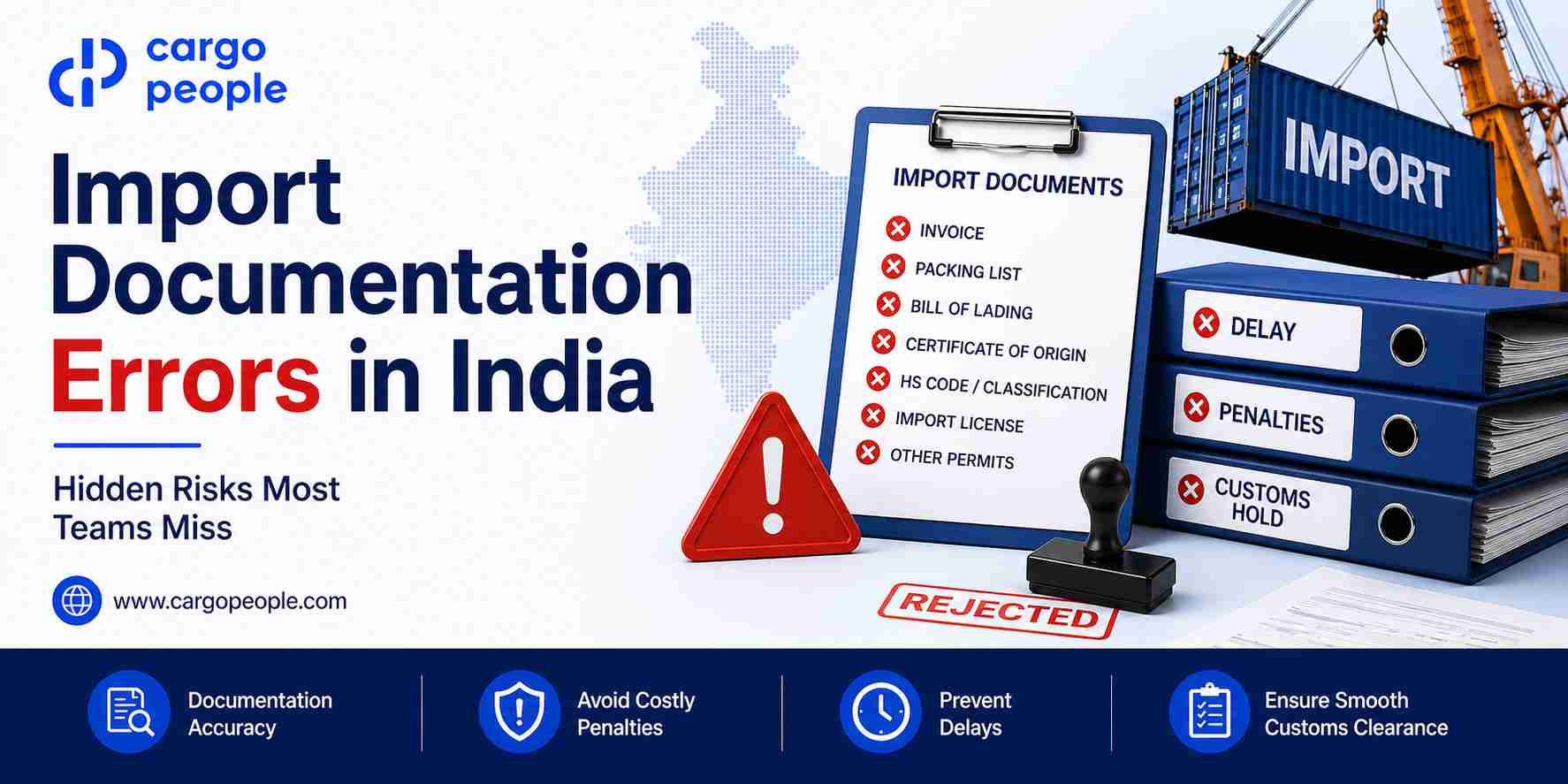
In 2025, an importer handling consumer goods shipments at Nhava Sheva port faced a clearance delay that extended beyond 96 hours instead of the expected 48-hour window. The issue was not port congestion or shipping delay. It was a simple mismatch between the HS code declared in the invoice and the one filed in the Bill of Entry.
The shipment was flagged by the ICEGATE system for reassessment. This triggered a physical inspection, increasing clearance time by another 48 hours. By the time the container was released, the importer had already incurred demurrage charges exceeding ₹30,000, along with detention charges from the shipping line.
This is not an isolated case. Across major ports like Mundra, Chennai, and Nhava Sheva, documentation errors remain one of the top reasons for avoidable delays and cost escalations in import shipments.
Why Import Documentation Errors Happen More Often Than Expected
Import documentation involves multiple stakeholders including exporters, importers, customs brokers, and freight forwarders. Each stakeholder handles a part of the documentation chain, and even a small misalignment can disrupt the entire process.
One of the most frequent issues is incorrect HS code classification. Since duty calculation, compliance checks, and risk assessment all depend on the HS code, even a minor error can trigger reassessment. Customs authorities may reclassify the product, leading to additional duty, penalties, or delays.
Another major reason is inconsistency between documents. If the commercial invoice, packing list, and Bill of Entry do not match in terms of product description, quantity, or value, the shipment is flagged for scrutiny. In India, around 10% to 20% of shipments are already subject to inspection, and documentation errors increase this probability significantly.
Missing regulatory documents is another critical issue. Certain products require BIS certification, DGFT licenses, or specific compliance approvals. If these are not submitted correctly, customs clearance cannot proceed regardless of other documentation being accurate.
Step-by-Step Import Documentation Workflow in India
The import process in India follows a structured flow, and documentation plays a central role at every stage. The process begins at the origin where the exporter prepares the commercial invoice, packing list, and transport document such as Bill of Lading or Airway Bill.
Once the cargo arrives at the destination port or airport, the importer or customs broker files the Bill of Entry through ICEGATE. This must be done ideally before or within 24 hours of cargo arrival to avoid delays.
Customs authorities then assess the shipment based on declared value, HS code, and compliance requirements. If all documents are aligned, clearance is typically completed within 24 to 72 hours. However, if discrepancies are found, the shipment is either reassessed or sent for inspection, extending the timeline.
📊 TABLE 1 — Import Logistics Process
| Stage | Authority | Timeline | Documents | Risk |
|---|---|---|---|---|
| Cargo Arrival | Port / Airport | Day 0 | BL / AWB | Delay if pre-filing not done |
| Bill of Entry Filing | ICEGATE | Within 24 hrs | Invoice, Packing List | Filing delay |
| Duty Assessment | Customs | 24–48 hrs | HS Code | Misclassification |
| Inspection (if flagged) | Customs | +24–48 hrs | All documents | Physical delay |
| Final Clearance | Customs | 1–3 days | Complete set | Demurrage risk |
Critical Import Documents and Where Teams Go Wrong
Each document in the import process has a defined purpose, and errors in any one of them can halt clearance. The commercial invoice is used for duty calculation, and any mismatch in value can trigger reassessment. The packing list must accurately reflect cargo details, as discrepancies in quantity or weight can lead to inspection.
The Bill of Lading or Airway Bill acts as the transport document, and errors in consignee details or shipment information can create legal and operational issues. The Bill of Entry is the most critical document filed with customs, and even minor mistakes here can delay clearance significantly.
📊 TABLE 2 — Documentation Risks
| Document | Issued By | Purpose | Risk |
|---|---|---|---|
| Commercial Invoice | Exporter | Value declaration | Under/over valuation |
| Packing List | Exporter | Cargo details | Quantity mismatch |
| Bill of Lading / AWB | Carrier | Transport proof | Name mismatch |
| Bill of Entry | Importer / CHA | Customs filing | Filing errors |
| Certificate of Origin | Authority | Duty benefit | Invalid claim |
The Real Cost of Import Documentation Errors
The financial impact of documentation errors goes beyond penalties. The biggest cost driver is delay. When a shipment is held at port due to documentation issues, demurrage charges start accumulating almost immediately after the free period.
At Indian ports, demurrage typically ranges between ₹7,000 to ₹15,000 per day per container. Shipping lines also impose detention charges if containers are not returned within the allowed time, which can range from ₹5,000 to ₹12,000 per day.
Even a 3-day delay can result in additional costs of ₹20,000 to ₹45,000 per container. For businesses importing multiple containers, these costs scale quickly and directly impact margins.
Air freight shipments, although faster, are equally sensitive. Delays at airport cargo terminals can lead to storage charges and missed delivery commitments, especially for time-sensitive goods like electronics or pharmaceuticals.
Risks and Delays That Disrupt the Entire Supply Chain
Documentation errors create a ripple effect across the logistics chain. A mismatch in documentation can trigger customs holds, which delay container movement and increase exposure to port congestion.
Incorrect HS classification often results in reassessment, adding at least 24 to 48 hours to the clearance process. Missing compliance documents can stop clearance entirely until corrections are made. In some cases, shipments are subjected to 100% inspection, significantly increasing delay.
Operationally, these delays affect container turnaround time, which is critical for shipping schedules. This can also result in rolled shipments or delayed inland transportation, further impacting delivery timelines.
Practical Business Scenarios Importers Face
A textile importer at Mundra port experienced a delay of 3 days due to incorrect product description in the invoice. The cargo was flagged for inspection, resulting in demurrage charges of over ₹20,000.
An electronics importer using air freight faced a 48-hour delay because of missing compliance certification. This delay disrupted distributor commitments and led to additional storage charges.
In another case, a machinery importer faced a 5-day delay after customs reassessed the declared value. The extended clearance timeline impacted project execution and increased overall logistics cost significantly.
How Businesses Can Avoid Import Documentation Errors
Avoiding documentation errors requires a proactive and structured approach. The process must begin at the origin itself, where documents are prepared. Ensuring alignment between invoice, packing list, and HS code classification is critical.
Pre-filing the Bill of Entry before cargo arrival can significantly reduce clearance time. Businesses should also ensure that all regulatory requirements such as BIS certification or DGFT licenses are fulfilled in advance.
Working with experienced logistics professionals helps in validating documentation before submission. This reduces the risk of errors and ensures smoother clearance.
The Role of a Freight Forwarder in Documentation Accuracy
A freight forwarder plays a crucial operational role in managing documentation and ensuring compliance. Their involvement starts from shipment planning and extends to final delivery.
They coordinate with exporters to ensure documentation accuracy, validate HS codes, and manage customs filing through ICEGATE. They also monitor shipments and proactively resolve issues that may arise during clearance.
In complex shipments involving multiple stakeholders, this coordination becomes essential to avoid delays and control costs.
Conclusion
Import documentation errors in India are not minor administrative issues. They directly impact clearance timelines, increase inspection probability, and lead to significant financial losses through demurrage, detention, and operational disruptions.
A single documentation mistake can add 2 to 5 days to shipment timelines and increase costs by ₹25,000 to ₹50,000 or more. In a competitive business environment, such delays can disrupt supply chains and affect customer commitments.
Businesses that treat documentation as a strategic part of logistics planning are better positioned to control costs and ensure timely delivery. Working with experienced logistics partners helps reduce risk, improve efficiency, and maintain consistency in operations.
To streamline your import operations and avoid costly documentation errors, explore expert solutions at https://www.cargopeople.com/
 CTA – Cargo People Logistics
📞 +91 97174 65454
📧 wecare@cargopeople.com
👉 Get a Shipping Quote from Cargo People Logistics
FAQs
1. What are common import documentation errors in India?
Incorrect HS code, invoice mismatch, missing documents, and wrong product description.
2. How much delay can documentation errors cause?
Typically 2 to 5 days depending on inspection and reassessment.
3. What is the average demurrage cost in India?
₹7,000 to ₹15,000 per day per container.
4. Can wrong HS code lead to penalties?
Yes, penalties can go up to 100% of duty in severe cases.
5. How to avoid customs clearance delays?
Accurate documentation, pre-filing Bill of Entry, and compliance checks.