

 USA
USA
 United Kingdom
 Germany
 Argentina
 Australia
 Canada
 New Zealand
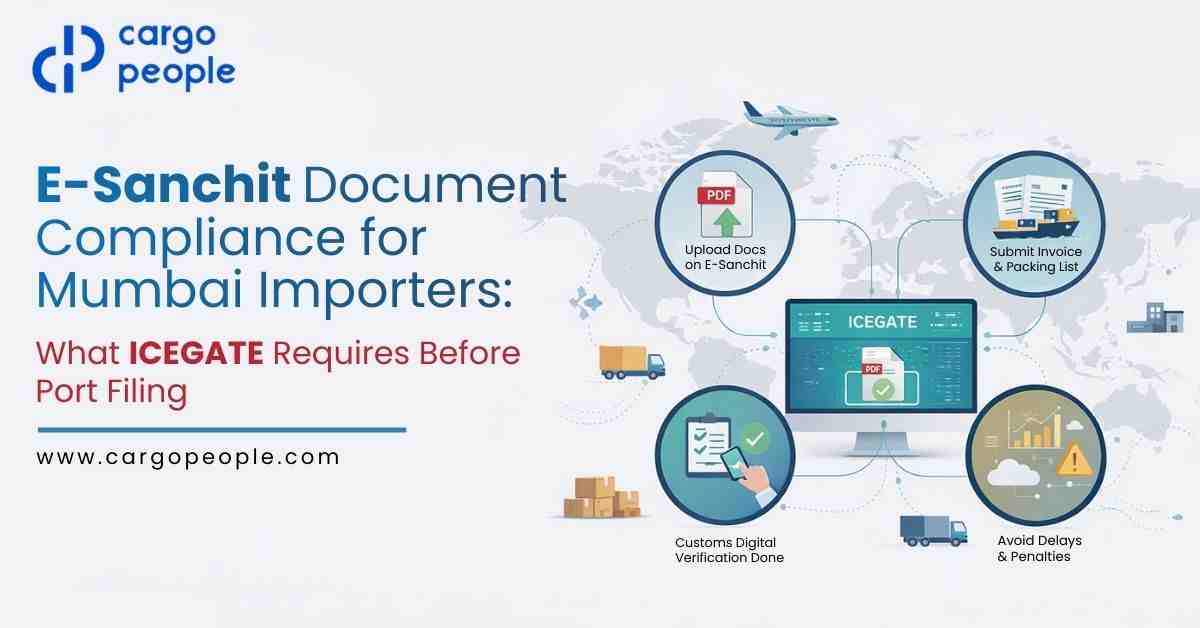
E-Sanchit is the electronic document management system integrated with the ICEGATE customs platform that allows importers and customs brokers to upload supporting documents before filing the Bill of Entry.
For shipments arriving through JNPT (Nhava Sheva Port) or Mumbai Air Cargo Complex, import documentation must be uploaded in E-Sanchit before customs officers begin duty assessment.
Typical documents uploaded include:
-
Commercial Invoice
-
Packing List
-
Bill of Lading or Airway Bill
-
Import License (if required)
-
Certificate of Origin
-
Insurance Certificate
Once uploaded, the system generates an Image Reference Number (IRN). This IRN must be referenced while filing the Bill of Entry on ICEGATE.
If documentation is incomplete or incorrectly uploaded, customs clearance may be delayed by 24–72 hours, increasing cargo dwell time and triggering demurrage charges between ₹7,000 and ₹15,000 per container per day at major ports like JNPT.
Why E-Sanchit Compliance Matters for Mumbai Importers
For importers using Mumbai’s major gateways such as JNPT, Nhava Sheva, and Mumbai Air Cargo Complex, customs documentation accuracy directly affects cargo clearance speed.
India handles more than 17 million TEUs of container cargo annually, and a significant share of this volume moves through western ports.
JNPT alone processes over 6 million TEUs every year, accounting for nearly 35–40% of India’s containerized trade.
Because of this scale, customs authorities rely heavily on digital documentation systems to manage cargo flow efficiently.
In practical terms, this means importers must ensure that all supporting documents are uploaded correctly on ICEGATE before filing the Bill of Entry.
When documents are missing or incorrectly uploaded:
-
Customs assessment cannot begin
-
Cargo remains at the terminal
-
Storage charges begin accumulating
Many importers discover documentation errors only after the shipment arrives at port, when delays become expensive.
Even a 48-hour delay in customs clearance can increase logistics costs by ₹20,000–₹50,000 per container, depending on shipping line and terminal storage policies.
How the E-Sanchit System Works on ICEGATE
E-Sanchit was introduced to eliminate physical paperwork from the customs clearance process.
Before the system was implemented, importers had to submit multiple physical document copies to customs officers at ports and airports.
Today, the entire process is digital.
The E-Sanchit system allows:
-
Electronic document submission
-
Secure document storage
-
Faster customs verification
-
Reduced paperwork handling
-
Centralized document reference
Each uploaded document receives a unique Image Reference Number (IRN).
The IRN acts as a digital reference that connects the document to the Bill of Entry filing process.
Customs officers reviewing import shipments can immediately access these documents through ICEGATE without requiring physical paperwork.
This significantly speeds up clearance when documentation is complete and accurate.
ICEGATE E-Sanchit Documentation Process for Imports
For shipments arriving at Mumbai ports or airport cargo terminals, the E-Sanchit documentation workflow follows several operational steps.
Step 1 — Cargo Arrival at Port or Airport
Container shipments typically arrive at Jawaharlal Nehru Port Trust (JNPT), located in Nhava Sheva near Mumbai.
JNPT handles:
-
more than 6 million TEUs annually
-
over 5,000 container vessel calls every year
-
approximately 30%–35% of India’s container trade
Air cargo shipments arrive at the Mumbai Air Cargo Complex, which processes over 800,000 tonnes of cargo annually.
Once cargo arrives, the shipment becomes eligible for customs clearance.
However, customs processing cannot begin until the importer files the Bill of Entry.
Step 2 — Import Documentation Preparation
Before customs filing begins, importers must ensure that all documentation required for clearance is prepared correctly.
Typical import documentation includes:
-
commercial invoice showing shipment value
-
packing list detailing cargo contents
-
Bill of Lading or Airway Bill issued by carrier
-
insurance certificate
-
import licenses for restricted goods
-
certificate of origin for duty benefits
Errors in documentation are one of the most common reasons for customs delays.
For example:
-
Incorrect HS codes may trigger duty reassessment
-
Missing packing details may lead to cargo inspection
-
Value discrepancies may require additional documentation
Across major Indian ports, approximately 10–20% of shipments are selected for customs inspection under the Risk Management System.
Proper documentation significantly reduces the likelihood of inspection.
Step 3 — Uploading Documents on E-Sanchit
Once documents are prepared, they must be uploaded electronically through the ICEGATE E-Sanchit portal.
The upload process involves:
-
scanning documents into PDF format
-
digitally signing documents using authorized credentials
-
uploading files into the ICEGATE system
-
tagging documents to the shipment
After successful upload, ICEGATE generates an Image Reference Number (IRN).
This IRN becomes the official digital reference for the uploaded document.
For most shipments, 4 to 6 documents are uploaded during this stage.
Step 4 — Bill of Entry Filing on ICEGATE
After documents are uploaded, the importer or customs broker files the Bill of Entry.
The Bill of Entry contains:
-
importer details
-
shipment description
-
HS classification
-
cargo value
-
duty calculation
While filing the Bill of Entry, the system requires the IRN numbers generated during E-Sanchit upload.
Without valid IRNs, the Bill of Entry cannot move to the next stage of customs processing.
Step 5 — Customs Duty Assessment
Once the Bill of Entry is filed successfully, customs officers begin duty assessment.
The duty payable depends on several factors:
-
HS classification
-
cargo value
-
country of origin
-
applicable trade agreements
-
anti-dumping duties or safeguard duties
For many import shipments, duty assessment may be completed within 4–12 hours if documentation is correct.
Step 6 — Customs Risk Management and Inspection
India uses a Risk Management System (RMS) to determine whether cargo should be inspected.
Based on cargo profile and documentation:
-
about 80–90% of shipments receive facilitated clearance
-
approximately 10–20% undergo physical examination
Inspection may involve:
-
container scanning
-
cargo verification
-
documentation cross-checks
If discrepancies are discovered during inspection, customs may request additional documents or clarification.
Step 7 — Out-of-Charge (Cargo Release)
Once customs processing is completed, ICEGATE issues an Out-of-Charge (OOC) order.
This indicates that customs clearance is complete and cargo may be released.
The container can then be:
-
moved to importer warehouse
-
transported to inland cities
-
delivered to manufacturing facilities
The entire clearance process typically takes 24–72 hours, depending on documentation accuracy and inspection requirements.
Logistics Process Overview
| Process Stage | Authority | Typical Timeline | Documents Required | Risk if Delayed |
|---|---|---|---|---|
| Cargo Arrival | Port Terminal | Same day | Bill of Lading | Terminal storage |
| E-Sanchit Upload | Importer / CHA | 1–2 hours | Invoice, Packing List | Filing rejection |
| Bill of Entry Filing | ICEGATE | Same day | IRN numbers | Clearance delay |
| Duty Assessment | Customs | 4–12 hours | Import documentation | Cargo hold |
| Customs Inspection | Customs | 12–48 hours | Shipment documents | Storage charges |
| Out-of-Charge Release | Customs | Same day | Final documents | Delivery delay |
Even a 1-day delay in documentation can significantly increase logistics costs due to port storage and container demurrage.
Documentation Checklist for E-Sanchit Compliance
| Document | Issued By | Required For | Submission Stage | Risk if Missing |
|---|---|---|---|---|
| Commercial Invoice | Exporter | Duty assessment | E-Sanchit upload | Filing rejection |
| Packing List | Exporter | Cargo verification | E-Sanchit upload | Inspection delay |
| Bill of Lading / Airway Bill | Carrier | Cargo identification | Bill of Entry filing | Cargo hold |
| Import License | DGFT | Restricted goods | E-Sanchit upload | Customs penalty |
| Certificate of Origin | Export authority | Duty benefits | E-Sanchit upload | Higher duty |
| Insurance Certificate | Insurer | Cargo protection | Optional | Claim issues |
Logistics Cost Breakdown for Imports
Import shipments cleared through Mumbai ports involve multiple logistics cost components.
Typical import costs include:
-
ocean freight charges
-
terminal handling charges
-
customs duty and IGST
-
documentation and clearance fees
-
container demurrage charges
-
inland trucking costs
For container cargo arriving at JNPT, demurrage charges typically range between:
-
₹7,000 and ₹15,000 per container per day
If cargo remains at port beyond the free storage period of 3–5 days, these charges increase rapidly.
For example:
A 3-day delay may increase logistics costs by ₹20,000–₹40,000 per container depending on shipping line policies.
Logistics Risks Caused by Missing E-Sanchit Documents
Incomplete documentation can create several operational challenges during customs clearance.
Common risks include:
-
Bill of Entry rejection
-
customs assessment delays
-
physical cargo inspection
-
port storage charges
-
container demurrage
-
delayed delivery schedules
For importers managing time-sensitive supply chains, these delays can disrupt manufacturing schedules and inventory planning.
Real Importer Scenario
A Delhi-based electronics importer shipped container cargo through JNPT.
While preparing customs documentation, the packing list was not uploaded to the E-Sanchit system.
Because of this:
-
the Bill of Entry could not be processed
-
customs assessment was delayed by 3 days
-
container dwell time increased to 5 days
The shipment incurred ₹36,000 in demurrage and terminal storage charges before cargo was finally released.
Proper document verification before shipment arrival could have prevented the delay.
How Freight Forwarders Help Ensure E-Sanchit Compliance
Experienced freight forwarders and customs brokers play a crucial role in ensuring that documentation is prepared correctly before cargo arrives.
Professional logistics providers typically assist with:
-
document verification before shipment arrival
-
E-Sanchit document upload
-
ICEGATE Bill of Entry filing
-
customs coordination
-
shipment tracking
-
final delivery planning
Working with experienced freight forwarding partners reduces clearance risks and improves supply chain reliability.
Conclusion
E-Sanchit has become an essential part of India’s digital customs clearance system.
For importers clearing cargo through Mumbai ports such as JNPT or Nhava Sheva, correct document submission on ICEGATE is required before filing the Bill of Entry.
Incomplete documentation can delay customs clearance by 24–72 hours, increase cargo dwell time, and trigger demurrage charges between ₹7,000 and ₹15,000 per container per day.
By preparing documentation in advance and working with experienced freight forwarding partners, importers can ensure faster customs clearance and avoid unnecessary logistics costs.
CTA — Cargo People Logistics
📞 +91 97174 65454
📧 wecare@cargopeople.com
Get a Shipping Quote from Cargo People Logistics