
 USA
USA
 United Kingdom
 Germany
 Argentina
 Australia
 Canada
 New Zealand
An auto-components manufacturer in Pune once shipped a high-value consignment to Europe, confident about demand and delivery timelines. The goods reached Nhava Sheva on time — but the shipment was held for days. The reason? A missing certificate of origin that would have qualified the cargo for duty benefits under a free trade agreement. The delay not only increased demurrage costs but also strained the buyer relationship.
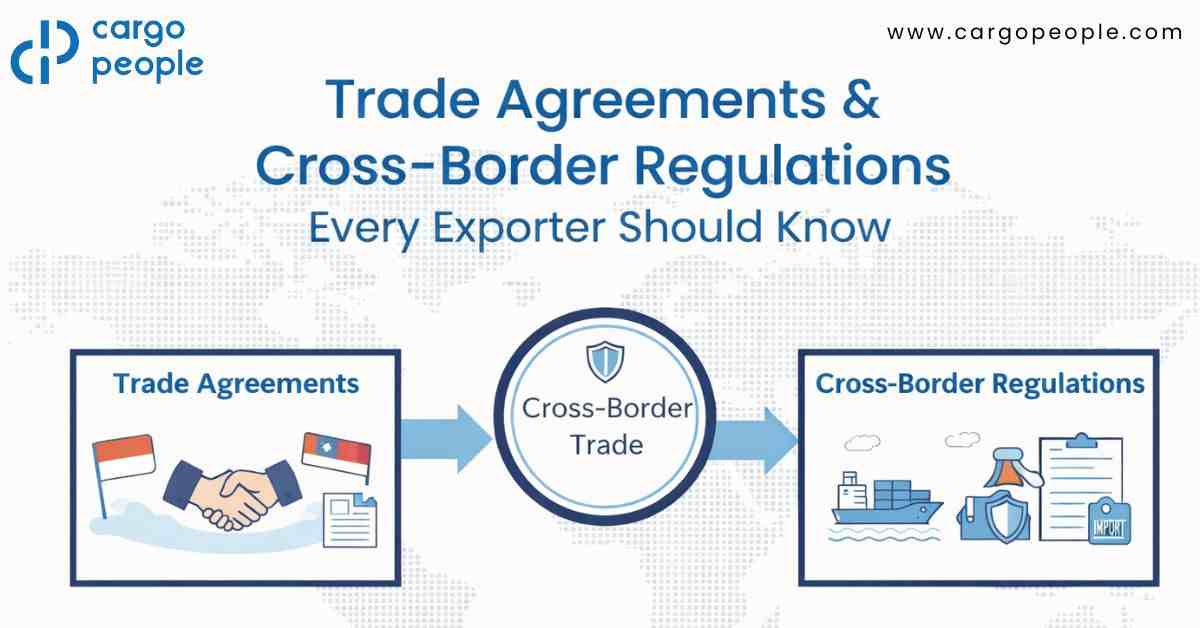
For Indian exporters, trade agreements and cross-border regulations are no longer policy-level concepts. They directly influence costs, delivery timelines, and competitiveness in global markets.
Why Export Trade Regulations Matter for Indian Businesses
Export trade regulations in India define how goods move across borders, how duties are calculated, and how compliance is verified at ports and airports. These regulations are enforced by authorities such as DGFT, CBIC, and Customs under the Foreign Trade Policy and Customs Act.
For exporters, the impact is practical and measurable:
-
Incorrect documentation can delay customs clearance
-
Non-compliance may attract penalties or shipment detention
-
Missed regulatory benefits can increase landed costs
Understanding regulations is not about paperwork alone — it’s about protecting margins and delivery commitments.
How Free Trade Agreements Benefit Indian Exporters
Free trade agreements signed by India aim to reduce or eliminate customs duties, simplify trade procedures, and improve market access. When used correctly, FTAs can significantly lower export costs and improve price competitiveness.
Key benefits for exporters include:
-
Reduced or zero customs duty in partner countries
-
Faster customs processing when documentation is accurate
-
Improved access to high-demand international markets
However, these benefits apply only when exporters meet specific eligibility criteria, particularly rules of origin and documentation requirements.
Major Free Trade Agreements India Has in Place
India currently has trade agreements with several key global regions, each offering sector-specific advantages.
| Trade Agreement | Partner Countries | Key Export Advantages |
|---|---|---|
| India–ASEAN FTA | Southeast Asia | Lower duties on textiles, engineering goods |
| India–UAE CEPA | United Arab Emirates | Duty-free access for gems, jewellery, food products |
| India–Japan CEPA | Japan | Tariff reductions on auto components and machinery |
| India–Korea CEPA | South Korea | Improved access for chemicals and steel products |
What this means for exporters:
Choosing the right trade route and understanding applicable agreements can significantly reduce overall export costs.
Understanding Rules of Origin and Their Business Impact
Rules of origin determine whether a product qualifies for FTA benefits. Customs authorities closely examine these rules to prevent misuse of duty concessions.
Common requirements include:
-
Minimum value addition in India
-
Product transformation criteria
-
Proper certification by authorized agencies
Failure to comply can result in duty recovery, penalties, and shipment delays. Exporters must align sourcing, production, and documentation with FTA rules before shipping.
Essential Customs Documentation for Cross-Border Trade
Customs documentation is the backbone of export compliance. Even minor discrepancies can trigger inspections or clearance delays.
Key documents Indian exporters must prepare include:
-
Commercial invoice and packing list
-
Shipping bill filed with Indian Customs
-
Certificate of origin for FTA claims
-
Export licenses or authorizations, if applicable
Proper documentation ensures smooth movement through ports such as Mundra, Nhava Sheva, Chennai, and Kolkata.
Customs Clearance Timelines Across Transport Modes
| Mode of Transport | Average Clearance Time | Business Implication |
|---|---|---|
| Sea Freight | 2–4 days | Requires buffer planning to avoid demurrage |
| Air Cargo | 1–2 days | Suitable for urgent and high-value exports |
| Rail Freight | 2–3 days | Cost-efficient for regional trade corridors |
Insight for exporters:
Selecting the right mode of transport based on urgency and compliance readiness helps reduce delays and inventory holding costs.
Compliance Risks Every Exporter Should Watch For
A pharmaceutical exporter in Hyderabad once faced shipment detention due to a mismatch between HS codes on the invoice and shipping bill. Customs reassessed the consignment, leading to additional duty and missed delivery deadlines.
Common risks include:
-
Incorrect HS classification
-
Missing or invalid certificates of origin
-
Incomplete export declarations
Proactive documentation checks and expert logistics support can prevent these issues before cargo reaches customs.
Real-World Export Success Stories
An apparel exporter in Tirupur reduced freight costs by over ₹2.5 lakh by consolidating shipments and using an FTA-backed export route to the UAE. With accurate documentation and route planning, the exporter also reduced clearance time at destination.
Similarly, a Mumbai-based engineering firm avoided penalties by pre-validating customs documentation with its freight forwarder before shipping to South Korea under CEPA benefits.
These outcomes show how regulatory knowledge directly translates into business advantage.
Preparing Your Export Business for Regulatory Compliance
To stay competitive in global markets, exporters should:
-
Regularly review applicable trade agreements
-
Align production and sourcing with rules of origin
-
Work with experienced freight forwarders for customs clearance
-
Plan shipments around port congestion and clearance timelines
Strategic logistics planning ensures compliance while protecting delivery commitments.
Conclusion: Turning Regulations into Export Advantage
Trade agreements and cross-border regulations can either slow down exports or become powerful tools for growth. Indian exporters who understand export trade regulations, leverage free trade agreements, and manage customs documentation effectively gain a clear competitive edge.
With the right logistics partner, compliance becomes a growth enabler rather than a risk.
Talk to Cargo People Logistics
📞 +91 9717465454
📧 wecare@cargopeople.com