
 USA
USA
 United Kingdom
 Germany
 Argentina
 Australia
 Canada
 New Zealand
Kochi-based exporter shipping processed food products to the Middle East faced an unexpected delay. The cargo was packed, containerized, and reached Cochin Port on time. Vessel cut-off was still 18 hours away.
Yet the shipment did not move.
The issue was not port congestion or shipping line delay. It was a DGFT compliance mismatch — the IEC was active, but not updated in the annual cycle, which led to rejection during shipping bill processing.
What followed:
- Cargo stuck at port for 3 days
- Missed vessel departure
- Demurrage charges of ₹9,500 per day
- Additional container detention of ₹6,000 per day
Total loss crossed ₹42,000, excluding reputational damage with the overseas buyer.
This is a common issue in Kochi. Most delays today are not operational — they are documentation and compliance failures.
Understanding IEC Registration & DGFT Compliance for Kochi Traders
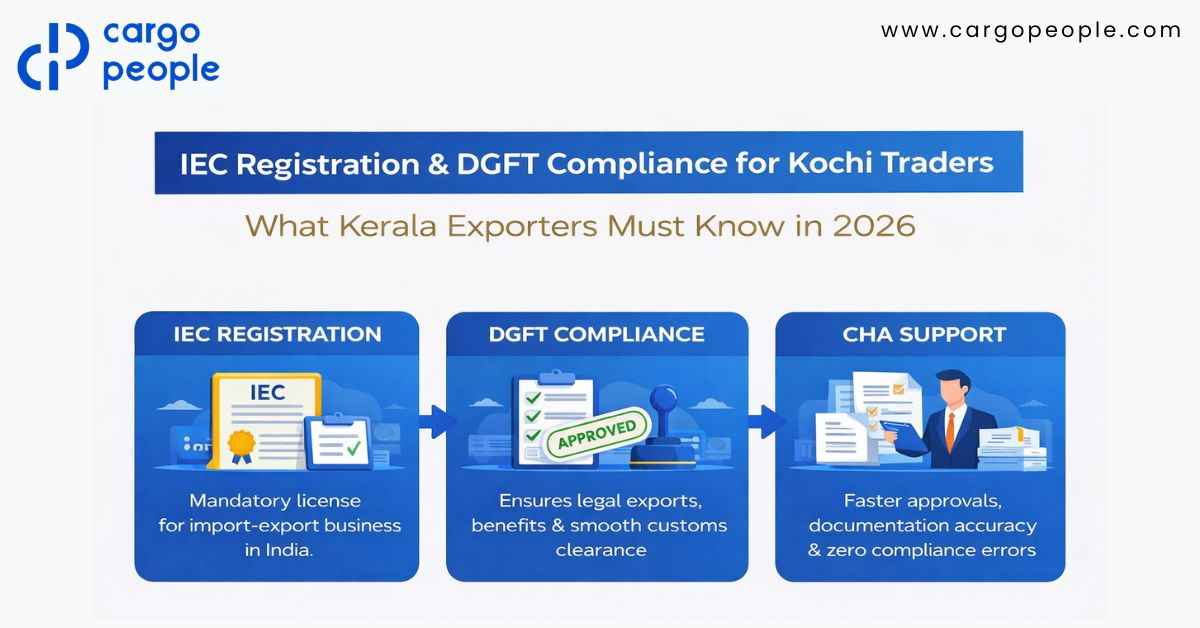
IEC (Importer Exporter Code) is not just a registration formality. It acts as the primary identity of an exporter across customs, DGFT, banks, and logistics systems.
Without IEC:
- Shipping bills cannot be filed
- Export proceeds cannot be realized
- Customs clearance is blocked
DGFT compliance ensures that your IEC is:
- Active and updated
- Linked with ICEGATE
- Eligible for export incentives
- Valid across all customs checkpoints
In 2026, compliance is increasingly digitized. Systems automatically flag mismatches, and rejection rates for incorrect filings have increased by 15–20% compared to previous years.
Step-by-Step IEC Registration & DGFT Compliance Process
IEC Registration Process for Kochi Exporters
The registration process is relatively fast, but accuracy is critical.
- Apply on DGFT portal using PAN
- Upload business registration proof
- Submit bank details for verification
- Aadhaar-based authentication
- IEC generated within 24–48 hours
However, nearly 1 in 5 applications face delays due to incorrect bank details or document mismatch.
DGFT Compliance Workflow for Export Operations
Once IEC is issued, operational compliance begins.
- Annual IEC update (mandatory)
- Linking IEC with ICEGATE system
- Registration for export incentive schemes
- Digital Signature Certificate validation
- Shipping bill filing before cargo cut-off
Each step directly impacts whether cargo clears in 24 hours or gets delayed by 2–4 days.
IEC Registration & DGFT Compliance Timeline at Kochi
| Process Stage | Authority | Typical Timeline | Documents Required | Risk if Delayed |
|---|---|---|---|---|
| IEC Application | DGFT | 24–48 hours | PAN, Bank Proof | Export cannot start |
| IEC Annual Update | DGFT | Same day | OTP verification | IEC suspension |
| ICEGATE Linking | CBIC | 1–2 days | IEC, GST | Filing failure |
| Shipping Bill Filing | Customs | 12–24 hours | Invoice, Packing List | Cargo hold |
| Export Clearance | Customs | 24–72 hours | Complete docs | Demurrage |
A delay of even 48 hours at any stage can increase total shipment cost by 8–12%.
Documentation Checklist for IEC & DGFT Compliance
Documentation accuracy is one of the most underestimated factors in export operations. In Kochi, nearly 25% of shipment delays are linked to incomplete or incorrect documentation.
| Document | Issued By | Required For | Submission Stage | Risk if Missing |
|---|---|---|---|---|
| PAN Card | Income Tax Dept | IEC registration | Initial stage | Application rejection |
| Bank Certificate | Bank | Financial validation | IEC filing | Delay in approval |
| GST Registration | GST Dept | Export filing | ICEGATE linking | Customs hold |
| Commercial Invoice | Exporter | Shipment value declaration | Shipping bill | Clearance delay |
| Packing List | Exporter | Cargo details | Inspection stage | Inspection issues |
Why Documentation Accuracy Matters
- Reduces customs queries by 20–30%
- Speeds up clearance by 24–48 hours
- Minimizes inspection probability
Key DGFT Compliance Requirements for Kochi Exporters
1. Annual IEC Update
IEC must be updated every year, even if no business changes occur.
Failure can result in:
- IEC becoming inactive
- Shipping bill rejection
- Export delays of 2–7 days
2. ICEGATE System Integration
Without ICEGATE linkage:
- Shipping bills cannot be processed
- Customs clearance is blocked
In Kochi, system-related mismatches contribute to nearly 10–15% of export delays.
3. Export Incentive Compliance
Exporters must register correctly for schemes such as:
- RoDTEP
- Advance Authorization
Failure to comply can lead to:
- Loss of 2–5% export margins
- Delayed refund processing
Logistics Cost Breakdown for Kochi Export Shipments
Exporters often focus only on freight cost, but compliance failures create hidden expenses.
Standard Export Cost Components
- Ocean freight charges
- Terminal Handling Charges: ₹3,000–₹8,000
- Documentation charges: ₹2,000–₹5,000
- CHA (Customs clearance) fees
- Inland transportation
Hidden Costs Due to Compliance Errors
- Demurrage: ₹7,000–₹15,000 per day
- Container detention: ₹5,000–₹12,000 per day
- Missed vessel rebooking charges
A delay of just 3 days can increase total logistics cost by ₹20,000–₹60,000.
Logistics Risks & Delay Factors in Kochi Exports
Kochi Port handles a significant volume of containerized and bulk cargo, but compliance-related delays remain a major challenge.
Common Risks
- Incorrect IEC data
- Expired IEC (not updated annually)
- HS code mismatch
- DGFT filing errors
- Shipping bill rejection
Operational Impact
- Customs inspection rate: 10–20% shipments
- Average dwell time increase: 2–3 days
- Vessel cut-off miss risk: high for late filings
Practical Business Scenario
A Kerala-based seafood exporter faced repeated delays due to incorrect IEC linkage with ICEGATE.
Impact:
- 2 shipments delayed by 3 days each
- Demurrage cost: ₹54,000
- Buyer imposed penalty for late delivery
After restructuring compliance with a freight forwarder:
- Clearance time reduced to 48 hours
- Zero demurrage in next 5 shipments
When Should Kochi Businesses Focus Strongly on DGFT Compliance
DGFT compliance becomes critical in the following cases:
- High-frequency exporters
- Time-sensitive shipments
- Perishable cargo like seafood
- Exporters claiming incentives
Industries Where Compliance is Most Critical
- Marine and seafood exports
- Spices and agricultural products
- Pharmaceutical exports
- Industrial machinery exports
Role of Freight Forwarders in IEC & DGFT Compliance
A freight forwarder acts as the operational bridge between exporter, customs, and DGFT systems.
They help in:
- IEC registration and updates
- DGFT filing accuracy
- ICEGATE integration
- Documentation validation
- Customs coordination
With professional handling:
- Clearance delays reduce by 30–40%
- Documentation errors reduce significantly
- Shipment predictability improves
Conclusion: IEC Registration & DGFT Compliance is a Cost Control Factor
For Kochi exporters, IEC registration and DGFT compliance are not just regulatory steps — they directly influence:
- Shipment timelines
- Export profitability
- Customer commitments
- Logistics cost control
In a port environment where even a 24-hour delay can cost ₹10,000+, compliance becomes a business-critical function.
Companies that treat compliance as a strategic process — not just paperwork — consistently achieve:
- Faster cargo movement
- Lower demurrage exposure
- Better global trade reliability
CTA — CARGO PEOPLE
📞 +91 97174 65454
📧 wecare@cargopeople.com
👉 Get a Shipping Quote from Cargo People Logistics