

 USA
USA
 United Kingdom
 Germany
 Argentina
 Australia
 Canada
 New Zealand
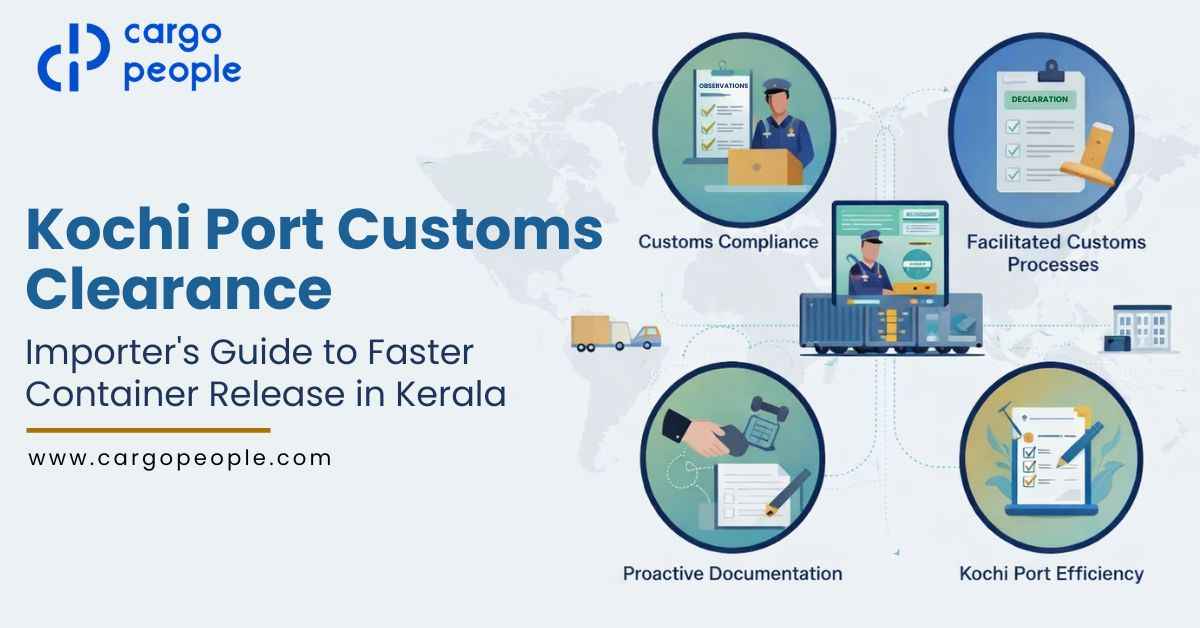
Kochi Port customs clearance in 2026 typically takes 24 to 72 hours for most import containers when documentation is accurate and the shipment is not selected for customs examination.
The process involves several operational stages beginning from container discharge at the terminal to final cargo release. These stages include Import General Manifest filing, Bill of Entry submission through ICEGATE, customs duty assessment, risk management screening, and final Out-of-Charge approval.
In practical logistics operations, the majority of shipments clear within 48 hours. However, documentation discrepancies or customs inspections may increase container dwell time to 4–6 days, leading to significant demurrage costs.
For businesses importing machinery, electronics, chemicals, or industrial components through Kochi Port, understanding the clearance workflow is essential to avoid operational disruptions.
Why Import Containers Get Delayed at Kochi Port
Despite improvements in digital customs systems and ICEGATE automation, delays still occur at Kochi Port due to operational issues related to documentation accuracy and compliance verification.
In early 2026, a Coimbatore-based industrial equipment importer shipped two containers of manufacturing components from Shanghai through Kochi Port. The shipment arrived on schedule, but customs authorities requested clarification because the HS code declared in the Bill of Entry did not match the product description mentioned in the commercial invoice.
As a result, the container was selected for inspection and the clearance timeline extended significantly.
The operational impact included:
-
Customs inspection delay of approximately 32 hours
-
Container dwell time increasing from 2 days to nearly 5 days
-
Demurrage cost reaching ₹27,000
-
Additional CHA documentation charges of ₹8,000
For importers managing shipments valued between ₹40 lakh and ₹3 crore per container, even a two-day delay can affect production schedules and inventory planning.
Kochi Port Container Operations and Capacity in 2026
Kochi Port has grown into one of South India’s key logistics gateways, handling a significant portion of cargo entering Kerala and nearby industrial regions.
The port’s container operations are primarily managed through Vallarpadam International Container Transshipment Terminal, India’s first dedicated container transshipment facility.
In 2026, Kochi Port is expected to handle approximately 40–45 million tonnes of cargo annually, with container throughput exceeding 850,000 TEUs.
Operational performance indicators at the port include:
-
Average vessel turnaround time of 22–28 hours
-
Typical container dwell time of 3–4 days
-
Daily truck movement of 1,800 to 2,200 vehicles
-
Yard utilization rates often reaching 80–85% during peak periods
The port serves major industrial regions including Bangalore, Coimbatore, Ernakulam, and Trivandrum.
Key trade routes connected to Kochi Port include Middle East shipping corridors with transit times of 6–8 days, Southeast Asian routes averaging 7–11 days, and East Asian routes such as China with transit times between 12–17 days.
Operational Process of Kochi Port Customs Clearance
The customs clearance process at Kochi Port follows a structured operational sequence designed to ensure regulatory compliance while maintaining cargo flow efficiency.
1. Container Arrival and Discharge
When a vessel reaches Kochi Port, containers are unloaded at the Vallarpadam terminal using ship-to-shore cranes and transferred to container yards.
This process typically takes 4 to 8 hours, depending on vessel size and cargo volume.
Once containers are placed in the yard, they remain under customs control until clearance procedures are completed.
2. Import General Manifest Filing
Before the customs clearance process can begin, the shipping line must file the Import General Manifest (IGM) with customs authorities.
The manifest includes critical shipment data such as consignee information, container numbers, cargo description, and weight.
In most cases, IGM filing occurs 12–24 hours before vessel arrival. Errors in manifest filing can delay cargo clearance by 12–24 hours.
3. Bill of Entry Filing Through ICEGATE
The importer or customs broker files the Bill of Entry electronically through the ICEGATE customs portal.
This document is the formal declaration used for calculating import duty and verifying compliance with import regulations.
The filing process usually requires 4–6 hours for system processing after documentation preparation.
Shipments valued above ₹1 crore often undergo additional verification during this stage.
4. Customs Duty Assessment
Customs authorities review the declaration to verify cargo classification and determine applicable duties.
During this stage, officials examine the HS code, invoice value, and applicable GST and customs duties.
Duty assessment typically takes 6–12 hours, although valuation disputes can extend this stage to 24 hours or more.
5. Risk Management Screening
Customs authorities use an automated Risk Management System to determine whether a shipment requires physical inspection.
Current operational data indicates that:
-
Approximately 75–80% of shipments are cleared without inspection
-
Around 15–18% are selected for routine examination
-
About 2–5% undergo detailed inspection
This automated system significantly reduces clearance delays for compliant importers.
6. Cargo Examination
If a shipment is selected for inspection, customs officers verify cargo details through container scanning and physical examination.
Inspection timelines generally range between 6 and 24 hours, although specialized cargo inspections may take up to 36 hours.
7. Out-of-Charge Release Order
After duty payment and inspection clearance, customs authorities issue an Out-of-Charge order.
This order authorizes the release of cargo from the port terminal.
The approval process usually takes 2–4 hours.
8. Container Gate-Out and Delivery
Following customs clearance, the importer settles terminal handling charges and obtains the delivery order from the shipping line.
The container is then loaded onto trucks for inland transport.
The final gate-out process typically takes 4–10 hours, depending on terminal traffic and truck availability.
Container Clearance Timeline at Kochi Port
| Process Stage | Authority | Typical Timeline | Documents Required | Risk if Delayed |
|---|---|---|---|---|
| Container discharge | Port terminal | 4–8 hours | Bill of Lading | vessel congestion |
| Manifest filing | Shipping line | 2–6 hours | Import General Manifest | cargo hold |
| Bill of Entry filing | CHA / importer | 6–12 hours | invoice, packing list | customs delay |
| Duty assessment | Customs | 6–12 hours | HS code, invoice | duty dispute |
| Cargo inspection | Customs | 12–36 hours | cargo description | demurrage |
| Out-of-Charge order | Customs | 2–4 hours | cleared documents | release delay |
| Container gate-out | Terminal | 4–10 hours | delivery order | detention |
Import Cost Structure for Kochi Port Shipments
Import shipments entering Kochi Port involve several logistics cost components that businesses must plan for.
Ocean freight charges vary depending on origin ports and seasonal demand. Shipments from the Middle East typically cost between $800 and $1,300 per container, while shipments from China often range from $1,400 to $2,200 per container.
Terminal handling charges at Kochi Port generally range between ₹7,000 and ₹10,000 per container, covering unloading, yard storage, and port equipment usage.
Customs documentation charges handled by CHA service providers typically range from ₹5,000 to ₹14,000, depending on cargo complexity.
Demurrage charges apply when containers remain in the port yard beyond the free storage period, which is usually three days. Demurrage rates typically range from ₹8,000 to ₹16,000 per container per day.
For shipments delayed by five days, total demurrage charges can easily exceed ₹40,000.
Inland transportation costs vary based on destination. Truck transport from Kochi to Coimbatore generally costs ₹20,000–₹25,000, while delivery to Bangalore may range between ₹32,000 and ₹45,000.
Documentation Required for Kochi Port Customs Clearance
| Document | Issued By | Purpose | Submission Stage | Risk if Missing |
|---|---|---|---|---|
| Bill of Lading | Shipping line | cargo ownership verification | before clearance | cargo hold |
| Commercial Invoice | Exporter | duty assessment | Bill of Entry filing | valuation dispute |
| Packing List | Exporter | inspection verification | document review | inspection delay |
| Importer IEC | DGFT | import authorization | customs filing | clearance rejection |
| Bill of Entry | Importer / CHA | customs clearance | ICEGATE filing | cargo detention |
| Insurance certificate | Importer | cargo protection | document verification | financial risk |
Operational Risks Affecting Container Clearance
Importers using Kochi Port frequently face operational risks that affect clearance timelines.
One of the most common issues is HS code misclassification, which can trigger duty reassessment and delay container release by 24–48 hours.
Another frequent problem is incomplete documentation. Errors in invoices or packing lists may lead to customs queries and extend cargo dwell time from 3 days to 6 days.
Port congestion can also increase delays, particularly during peak shipping seasons when yard utilization exceeds 85% capacity.
If containers remain at the port beyond the free period for five days, demurrage and detention costs can exceed ₹50,000 per container.
How Freight Forwarders Improve Clearance Efficiency
Freight forwarders play a crucial role in ensuring faster customs clearance and smoother cargo operations.
By reviewing HS codes, invoices, and product descriptions before cargo arrival, forwarders reduce documentation errors that typically cause clearance delays.
They also monitor vessel arrival schedules and coordinate with customs brokers to ensure Bill of Entry filing happens immediately after container discharge.
Once cargo is cleared, freight forwarders arrange inland transportation and delivery planning to minimize storage charges.
Businesses importing regularly often reduce logistics costs by 10–15% through efficient freight forwarding coordination.
Conclusion
Kochi Port customs clearance in 2026 typically takes 24–72 hours when documentation is accurate and shipments are not selected for inspection.
However, errors in HS code classification, incomplete documents, or inspection procedures can extend clearance timelines to 4–6 days, significantly increasing logistics costs.
For businesses importing container shipments valued between ₹30 lakh and ₹3 crore, efficient customs clearance planning is critical to avoiding demurrage charges, supply chain delays, and operational disruptions.
Working with experienced freight forwarding professionals helps ensure faster cargo release, improved documentation accuracy, and smoother logistics operations.
CTA — Cargo People Logistics
📞 +91 97174 65454
📧 wecare@cargopeople.com