
 USA
USA
 United Kingdom
 Germany
 Argentina
 Australia
 Canada
 New Zealand
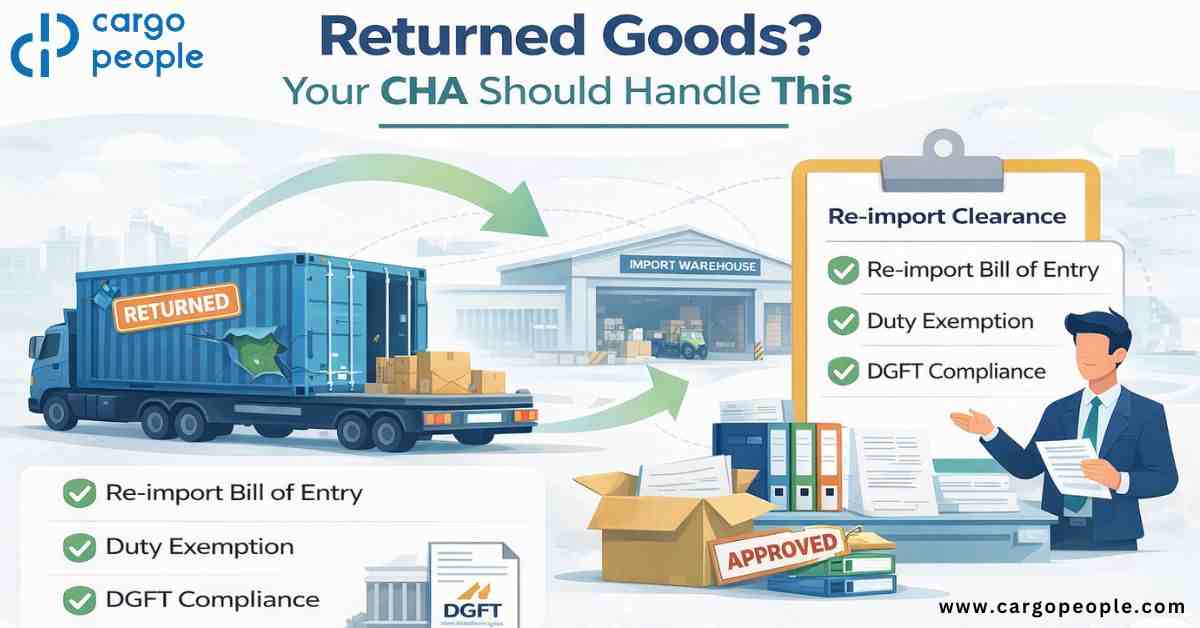
A Delhi-based machinery exporter shipped equipment to a European buyer. Within weeks, the goods were returned due to a minor specification mismatch. What should have been a routine return quickly turned into a logistical nightmare — customs queries, unexpected duty demands, and containers stuck at port. The problem wasn’t the product. It was the lack of planning for reverse logistics.
For Indian importers and exporters, returns are no longer rare exceptions. They are part of everyday trade. Managing them correctly requires more than transport — it requires the combined expertise of a Customs House Agent (CHA) and a freight forwarder who understand how reverse logistics actually works in India.
What Is Reverse Logistics and Why It Is Critical for Indian Trade
Reverse logistics refers to the movement of goods back through the supply chain — from customer to seller, distributor to manufacturer, or overseas buyer back to India. This could be due to rejection, warranty repair, replacement, recall, or surplus inventory.
In India’s trade environment, reverse logistics is far more complex than forward shipping. Forward shipments are planned, documented, and budgeted. Returns are often urgent, unplanned, and compliance-heavy.
For Indian businesses, reverse logistics directly impacts:
-
Working capital tied up in returned inventory
-
Customer satisfaction in after-sales service
-
Exposure to customs penalties and duplicate duties
-
Storage, demurrage, and detention costs
Without proper handling, returns can quickly turn profitable shipments into financial losses.
The Role of CHA in Reverse Logistics and Returned Shipments
A Customs House Agent is the single most important stakeholder when goods are being re-imported into India or sent back overseas. Reverse logistics is as much about compliance as it is about movement.
How a CHA Protects Businesses During Returns
A CHA ensures that returned goods are not mistakenly treated as fresh imports. This distinction alone can save businesses lakhs in unnecessary duty payments.
Their responsibilities include:
-
Correctly declaring returned goods under applicable re-import provisions
-
Linking return shipments with original export or import documents
-
Managing duty exemption, remission, or refund processes
-
Coordinating with customs officers to clarify intent and eligibility
-
Preventing shipment seizure, misclassification, or valuation disputes
In practice, the CHA acts as a buffer between the business and customs authorities, ensuring that documentation errors do not escalate into penalties.
What Happens Without CHA Involvement
Many businesses assume reverse logistics is only a transport issue. This assumption leads to:
-
Duplicate duty payments
-
Delayed clearance due to document queries
-
Inability to claim duty refunds later
-
Extended container detention at ports
A knowledgeable CHA prevents these problems before the shipment even lands.
The Role of Freight Forwarders in Return Shipping and Reverse Logistics
While the CHA manages compliance, the freight forwarder manages execution. In reverse logistics, execution is often more challenging than forward shipping because timelines are tight and costs are under scrutiny.
How Freight Forwarders Add Value in Reverse Logistics
Freight forwarders design the physical movement of returned goods in a way that balances speed, cost, and reliability.
Their role includes:
-
Evaluating whether air or sea freight makes commercial sense for returns
-
Coordinating overseas pickup from buyers, distributors, or service centers
-
Consolidating multiple return shipments to reduce freight costs
-
Planning routes and transit schedules to avoid port congestion
-
Aligning shipment arrival with customs readiness
For after-sales logistics, where margins are already thin, this optimization becomes critical.
How Reverse Logistics Works in Practice for Indian Businesses
Reverse logistics is not a single action. It is a coordinated sequence that requires planning at every stage.
A Typical Reverse Logistics Flow
-
Identification of return reason and commercial intent
-
Decision on re-import, re-export, repair, or disposal
-
Preparation of documentation referencing original shipments
-
Freight booking and overseas coordination
-
Customs filing and clearance in India
-
Final delivery to factory, warehouse, or service hub
When CHAs and freight forwarders work in isolation, this flow breaks down. When they collaborate, the process becomes predictable and efficient.
Choosing the Right Indian Port for Returned Cargo
Not all ports handle return cargo with the same efficiency. Port selection plays a major role in clearance timelines and cost control.
| Port | Operational Advantage | Ideal For |
|---|---|---|
| Nhava Sheva | Strong customs infrastructure | High-volume returns |
| Mundra | Faster evacuation | Time-sensitive cargo |
| Chennai | Sector expertise | Auto & electronics |
| Cochin | Lower congestion | Southern India cargo |
Business insight:
Selecting the right port can reduce dwell time, demurrage, and clearance friction for returned shipments.
Customs Clearance Timelines: Why Returns Take Longer
| Mode | Fresh Imports | Returned Shipments |
|---|---|---|
| Air Cargo | 1–2 days | 2–3 days |
| Sea LCL | 3–5 days | 5–7 days |
| Sea FCL | 4–6 days | 6–8 days |
What this means for businesses:
Returned shipments undergo additional verification. Advance documentation and CHA coordination can significantly reduce these delays.
Compliance and Operational Risks in Reverse Logistics
Reverse logistics failures rarely happen due to one big mistake. They usually happen due to several small oversights.
Common Risks Indian Businesses Face
-
Incorrect declaration of returned goods
-
Missing references to original shipping documents
-
Delay in filing refund or drawback claims
-
Poor coordination between overseas pickup and customs filing
Real Business Impact
-
Containers held at port for days
-
Escalating demurrage and storage costs
-
Cash flow disruption due to delayed refunds
-
Strained relationships with overseas customers
Proactive planning eliminates these risks before they occur.
Mini Business Stories — Practical, Real Outcomes
An electronics exporter in Bengaluru faced frequent overseas returns under warranty. By shifting to consolidated sea shipments with proper CHA documentation, the company reduced annual reverse logistics costs by over ₹3 lakh.
A Tirupur-based apparel manufacturer avoided duplicate customs duty on rejected export garments by correctly declaring re-import shipments, ensuring smooth clearance and faster resale.
These are not exceptions. They are outcomes of structured logistics planning.
Why Coordination Between CHA and Forwarder Matters
Reverse logistics sits at the intersection of compliance and movement. If either side fails, the entire process suffers.
When CHAs and freight forwarders work together, businesses benefit from:
-
Faster customs clearance
-
Lower freight and handling costs
-
Reduced regulatory exposure
-
Better after-sales performance
This coordination turns reverse logistics from a liability into a controlled process.
Conclusion — Making Reverse Logistics Work for Your Business
Reverse logistics is no longer an occasional disruption. For Indian exporters and importers, it is a recurring operational reality. Managing it without expert support leads to avoidable losses, delays, and compliance stress.
With the right CHA and freight forwarder partnership, businesses can control costs, protect margins, and maintain strong customer relationships — even when shipments move backward.
📞 +91 9717465454 | 📧 wecare@cargopeople.com
Book a Consultation with Cargo People Logistics