
 USA
USA
 United Kingdom
 Germany
 Argentina
 Australia
 Canada
 New Zealand
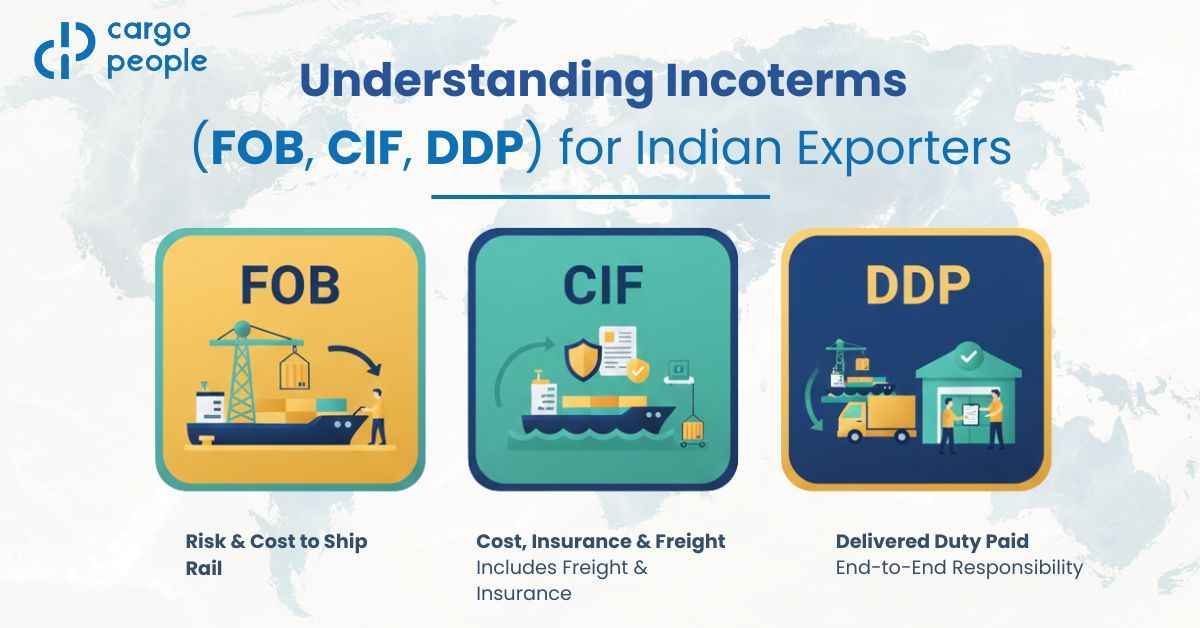
International trade doesn’t usually fail because of poor products.
It fails because of misaligned expectations — especially around who pays, who controls the shipment, and who carries the risk.
That’s exactly where Incoterms come in.
For Indian exporters shipping from ports like Mundra, Nhava Sheva, Chennai, or Kolkata, Incoterms are not just contractual terms. They directly influence freight cost, customs valuation, insurance claims, cash flow, and buyer relationships.
This guide breaks down FOB, CIF, and DDP in a way that reflects how exports actually work on the ground in India.
What Are Incoterms and Why Indian Exporters Must Get Them Right
Incoterms define the division of responsibility between exporter and importer — not just on paper, but in real operational terms.
They clarify:
-
Who arranges freight
-
Who pays which costs
-
Where the risk transfers
-
Who is responsible if something goes wrong
For Indian exporters, Incoterms have additional importance because they interact with:
-
Export customs procedures
-
GST and valuation rules
-
Bank documentation for payments
-
Freight forwarder coordination
A poorly chosen Incoterm can lead to:
-
Unexpected freight bills
-
Disputes over insurance coverage
-
Delays in customs clearance
-
Payment hold-ups under LC or DP terms
Simply put, Incoterms decide how smoothly your export transaction will run.
FOB (Free On Board) – The Most Exporter-Friendly Incoterm in India
FOB is widely used by Indian exporters across manufacturing hubs such as Pune, Tirupur, Ludhiana, Morbi, and Rajkot.
Under FOB, the exporter’s responsibility ends once the cargo is loaded on the vessel at the Indian port.
How FOB Works in Practical Indian Export Scenarios
The exporter:
-
Handles export documentation
-
Completes Indian customs clearance
-
Delivers cargo to the port and loads it on the vessel
Once the cargo is on board:
-
Risk transfers to the buyer
-
Buyer controls ocean freight and insurance
-
Exporter’s cost exposure is capped
Why FOB Aligns Well with Indian Export Operations
FOB works especially well in India because:
-
Customs valuation remains straightforward
-
GST refund processes are cleaner
-
Exporters avoid overseas freight disputes
-
Buyers with global contracts get better freight rates
For exporters dealing with regular buyers in the USA, Europe, or the Middle East, FOB provides clarity and predictability.
Business Impact of Choosing FOB
Exporters using FOB often experience:
-
Fewer payment disputes
-
Faster document acceptance by banks
-
Better margin control
-
Lower operational stress
That’s why FOB is often recommended as the default Incoterm for Indian exporters unless there’s a strong reason otherwise.
CIF (Cost, Insurance and Freight) – Control Comes with Responsibility
CIF is commonly requested by overseas buyers who want a “price including freight.”
While CIF can make your offer more attractive, it also shifts certain responsibilities to the exporter.
What CIF Really Means for Indian Exporters
Under CIF:
-
The exporter arranges ocean freight
-
The exporter provides insurance (minimum cover)
-
Risk still transfers at the Indian port of loading
This is where confusion often arises.
Many exporters assume CIF means they are responsible until the destination port. In reality, risk transfers much earlier, even though the exporter is paying for freight and insurance.
Hidden Commercial Risks in CIF
CIF can quietly affect profitability due to:
-
Freight rate volatility
-
Insurance coverage gaps
-
Limited control at the destination port
-
Disputes when damage occurs after loading
If freight costs rise suddenly, the exporter absorbs the impact unless pricing has been carefully planned.
When CIF Makes Strategic Sense
CIF works better when:
-
Exporters have negotiated stable freight contracts
-
Buyers demand a landed port price
-
Cargo is bulk, low-value, or commodity-based
-
Exporters are working with an experienced freight forwarder
CIF is not wrong — it just requires strong logistics planning.
DDP (Delivered Duty Paid) – High Convenience, High Risk
DDP appears attractive because it promises the buyer a “door-delivered” solution.
For Indian exporters, however, DDP can quickly become risky if not managed properly.
What DDP Actually Involves
Under DDP, the exporter:
-
Pays freight and insurance
-
Handles import customs clearance abroad
-
Pays destination duties and taxes
-
Delivers cargo to the buyer’s premises
This means the exporter must understand and comply with foreign customs and tax regulations.
Why DDP Is Risky for Indian Exporters
DDP exposes exporters to:
-
Foreign VAT or tax registration requirements
-
Customs delays outside their control
-
Unpredictable duty calculations
-
Demurrage and detention at overseas ports
Many Indian exporters underestimate how complex destination-country compliance can be.
When DDP Can Work
DDP is more suitable when:
-
The exporter has a local entity abroad
-
There is a long-term buyer relationship
-
A global logistics partner manages end-to-end compliance
For most Indian SMEs, DDP should be approached cautiously.
FOB vs CIF vs DDP – Responsibility Comparison for Indian Exports
| Area of Responsibility | FOB | CIF | DDP |
|---|---|---|---|
| Export customs (India) | Exporter | Exporter | Exporter |
| Ocean freight | Buyer | Exporter | Exporter |
| Insurance | Buyer | Exporter | Exporter |
| Import duty & tax | Buyer | Buyer | Exporter |
| Overall risk exposure | Low | Medium | Very High |
Key takeaway:
The more responsibility you take, the more operational and financial risk you carry.
Incoterms and Indian Ports – What Exporters Should Know
Different Indian ports see different Incoterm preferences based on trade lanes and buyer profiles.
| Port | Common Incoterms | Typical Trade Routes |
|---|---|---|
| Mundra | FOB | USA, Europe |
| Nhava Sheva (JNPT) | FOB, CIF | EU, Africa |
| Chennai | FOB | Southeast Asia |
| Kolkata | CIF | Bangladesh, Nepal |
Exporters shipping FOB from high-volume ports often benefit from:
-
Faster vessel connections
-
Better documentation flow
-
Lower congestion-related delays
A Real Export Lesson from the Ground
A textile exporter from Tirupur accepted DDP terms for a European buyer without understanding destination tax requirements.
The shipment reached on time, but customs clearance was delayed due to missing tax registration.
The outcome:
-
Unexpected holding charges
-
Delayed payment
-
Reduced profit on the order
In later shipments, the exporter switched to FOB and allowed the buyer to manage destination clearance — restoring margin stability.
How the Right Incoterm Improves Export Profitability
Choosing the correct Incoterm helps exporters:
-
Control freight and logistics costs
-
Avoid unnecessary liabilities
-
Reduce disputes with buyers
-
Speed up payment cycles
-
Focus on core manufacturing and sales
Incoterms are not legal jargon — they are business tools.
How Cargo People Helps Indian Exporters Choose the Right Incoterms
Cargo People Logistics & Shipping Pvt. Ltd. works closely with exporters to:
-
Align Incoterms with trade lanes
-
Match shipping terms to buyer expectations
-
Reduce customs and freight-related risks
-
Provide seamless freight forwarding and clearance support
📧 mis@cargopeople.com
Book a Consultation with Cargo People Logistics
FAQs – Incoterms & Export Shipping from India
Which Incoterm is safest for Indian exporters?
FOB is generally the safest and most balanced option.
Is CIF risky for exporters?
CIF carries moderate risk if freight and insurance are not planned carefully.
Why should Indian exporters avoid DDP?
DDP requires handling foreign duties, taxes, and compliance, which can be complex.
Do Incoterms affect customs valuation?
Yes, they directly impact assessable value and GST calculations.
Can freight forwarders advise on Incoterms?
Experienced freight forwarders help exporters choose cost-effective and compliant Incoterms.